

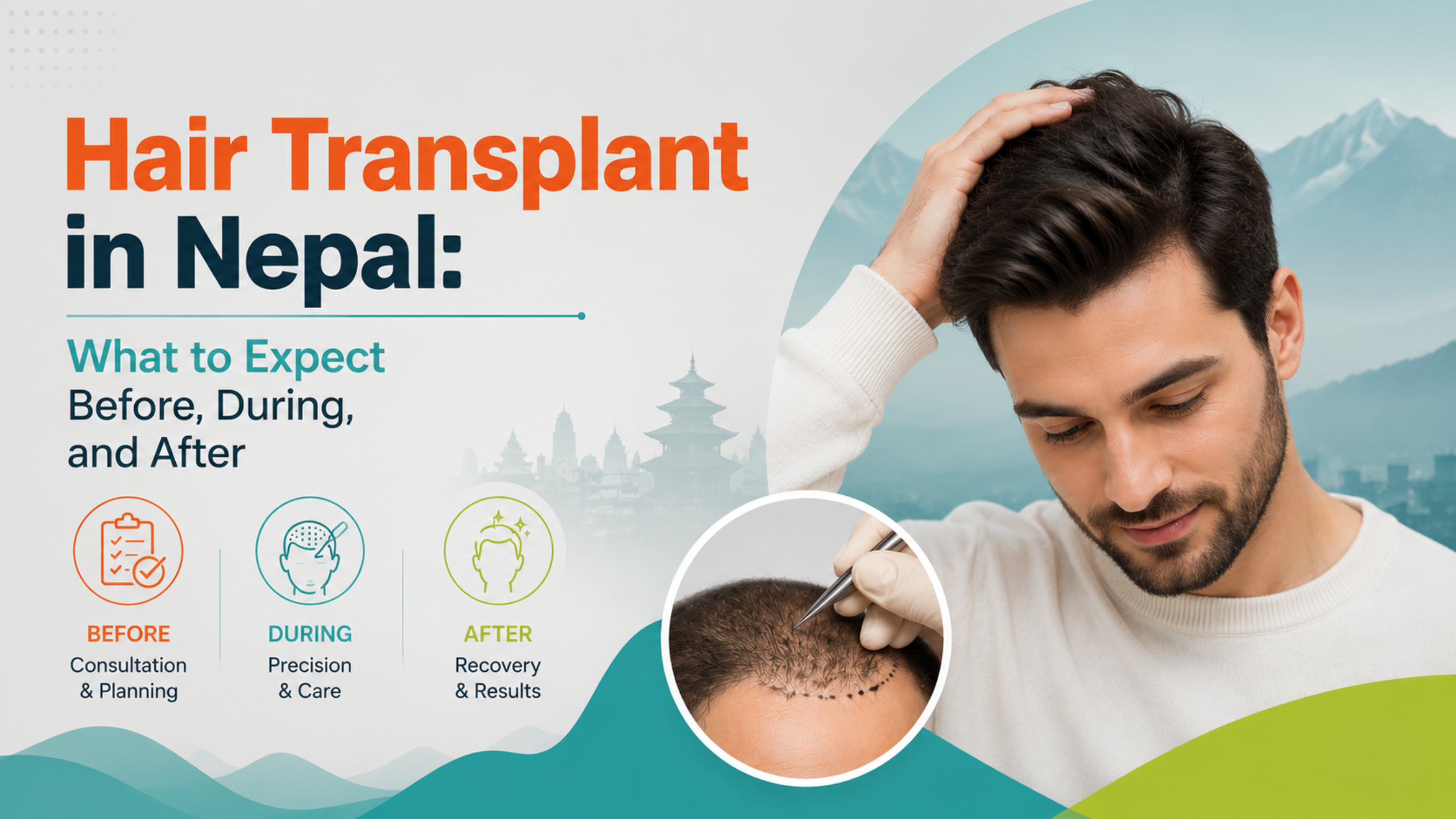
Hair transplant in Nepal has changed a lot in recent years. It used to be something people travelled abroad for. Now, it is done right here in Kathmandu, safely, permanently, and with results that look completely natural.
Hair loss affects millions of Nepali men and women. It hits confidence hard. Many people try shampoos, oils, and supplements for years without real results. If that sounds familiar, a hair transplant in Nepal might be exactly what you have been looking for.
This guide covers everything. What happens before the procedure? What happens on the day? What to expect week by week during recovery. And what your final results will look like. By the end, you will know exactly what to expect and whether a hair transplant in Nepal is right for you. Our hair transplant team at Nepal Skin Hospital is here to help you every step of the way.
What Is a Hair Transplant in Nepal and How Does It Work?
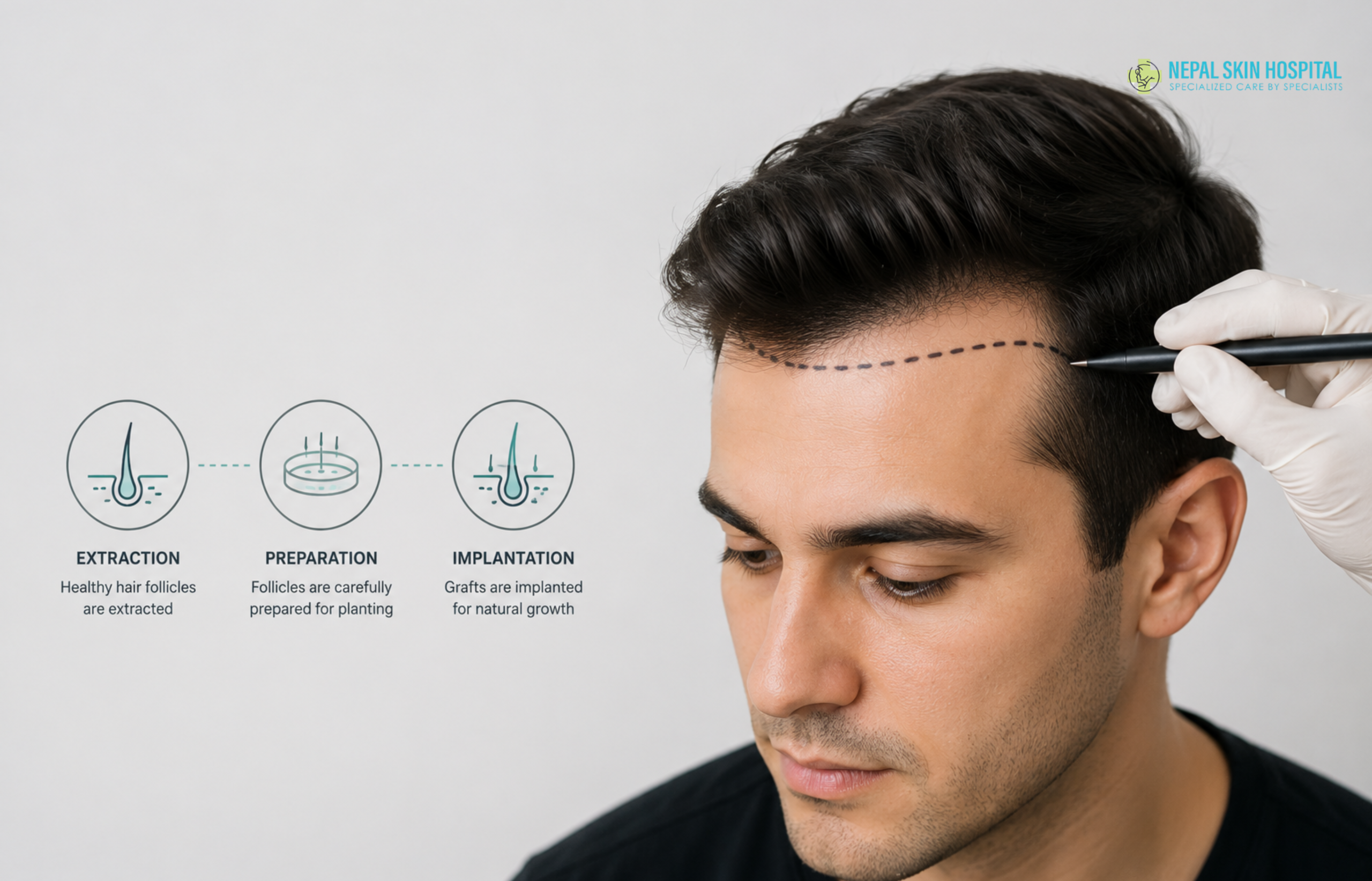
A hair transplant is a medical procedure. It moves healthy hair follicles from one part of your scalp to an area where hair is thin or missing.
The most important thing to understand is this: the hair used is your own. It comes from the back or sides of your scalp. Hair in these areas is genetically resistant to DHT, the hormone that causes most hair loss. That means the transplanted hair will not fall out like your original hair did. It grows for life.
At Nepal Skin Hospital, we use the FUE technique Follicular Unit Extraction. This is the most advanced and widely used method in the world today. Here is how it works:
- Individual hair follicles are extracted from the donor area one by one, using a precision motorised micro-punch less than 1mm wide.
- Each follicle is carefully prepared and stored to keep it healthy.
- Tiny channels are made in the recipient area, the bald or thinning zone.
- Follicles are placed into these channels with precision, following your natural hairline direction.
There are no stitches. There is no long scar. The tiny extraction points heal within three to four days. Most patients go home the same day.
The result is permanent, natural-looking hair that grows, can be cut, washed, and styled just like the rest of your hair.
Is a Hair Transplant in Nepal Right for You?
A hair transplant in Nepal works best for specific types of hair loss. Not everyone is a suitable candidate, and a good clinic will always tell you that honestly.
You are likely a good candidate if:
- You have male or female pattern baldness (androgenic alopecia) the most common cause of hair loss in Nepal
- You have a receding hairline or thinning at the crown
- You have lost hair due to an injury, burn, or trauma
- You want to restore your eyebrows, beard, or moustache
- You have enough healthy donor hair at the back and sides of your scalp
- Your hair loss has been stable for at least one year
- You are in good general health and have realistic expectations
You may not be a suitable candidate if:
- Your hair loss is still actively progressing
- You do not have enough donor hair to cover the area
- Your hair loss is caused by a medical condition that has not yet been treated
- You have certain health conditions that affect healing
Not sure if you qualify? The best way to find out is a consultation with our experienced dermatologists. They will assess your scalp, calculate your donor capacity, and give you an honest answer.
What to Do Before Your Hair Transplant in Nepal
Preparation matters. What you do in the days and weeks before your hair transplant in Nepal directly affects how well the procedure goes and how fast you recover.
Here is exactly what to do, and what to avoid:
2–4 weeks before
- Stop smoking completely. Smoking reduces blood flow to the scalp, slowing healing and reducing graft survival.
- Avoid alcohol for at least one week before the procedure. Alcohol thins the blood and increases bleeding.
- Stop taking blood-thinning medications, including aspirin, ibuprofen, and certain supplements like fish oil and vitamin E, unless your doctor has advised otherwise. Always check with your doctor first.
- Stay out of direct sunlight as much as possible. A sunburned scalp cannot be treated safely.
The night before
- Wash your hair thoroughly with a gentle, regular shampoo. Do not use any conditioner, oil, or styling products.
- Get a good night’s sleep. Arriving rested makes a real difference to how comfortable the day feels.
- Eat a normal meal. Do not come to the procedure on an empty stomach.
- Wear comfortable, loose clothing, preferably a shirt or top that buttons or zips at the front, so you do not have to pull anything over your head after the procedure.
On the morning of
- Do not apply any product to your hair or scalp.
- Take any prescribed pre-procedure medications exactly as instructed by your doctor.
- Arrive at the clinic on time. The procedure takes between 4 and 8 hours, depending on the number of grafts needed.
- Bring something to watch or listen to; most patients watch films or listen to music during the procedure.
What Happens During a Hair Transplant in Nepal: Step by Step
Here is exactly what happens on the day of your hair transplant in Nepal at Nepal Skin Hospital. Knowing each step in advance helps you feel calm and fully prepared.
- Consultation and hairline design. Before anything begins, your surgeon sits with you to understand your goals. Your new hairline is carefully mapped out designed to suit your face shape and look completely natural. This step is important. It determines how your final result will look.
- Scalp assessment and graft planning, the team calculates exactly how many grafts you need and plans how they will be distributed across the recipient area for the best possible density.
- Local anaesthesia, A local anaesthetic is applied to both the donor and recipient areas. You will feel a mild sensation during the injection — like a small pinch. After that, the area is fully numb. You will not feel pain during the procedure.
- Follicle extraction (FUE), Individual hair follicles are carefully extracted from the donor area using a precision motorised micro-punch. This is done one follicle at a time with great care to protect each graft.
- Graft preparation: Each extracted follicle is carefully prepared by the team. They are kept in a special solution to maintain their health before implantation.
- Channel creation: Tiny channels are made in the recipient area. The angle, depth, and direction of each channel determine how natural the final hairline looks.
- Follicle implantation: Each healthy follicle is placed into a channel. This is the most precise and time-consuming part of the procedure. It requires great skill to achieve a natural, dense result.
- Post-procedure care: Once complete, the area is cleaned, a protective dressing is applied, and you receive detailed aftercare instructions. You go home the same day.
The full procedure takes between 4 and 8 hours, depending on how many grafts are needed. Most patients feel relaxed and comfortable throughout.
Hair Transplant in Nepal: Week-by-Week Recovery Timeline
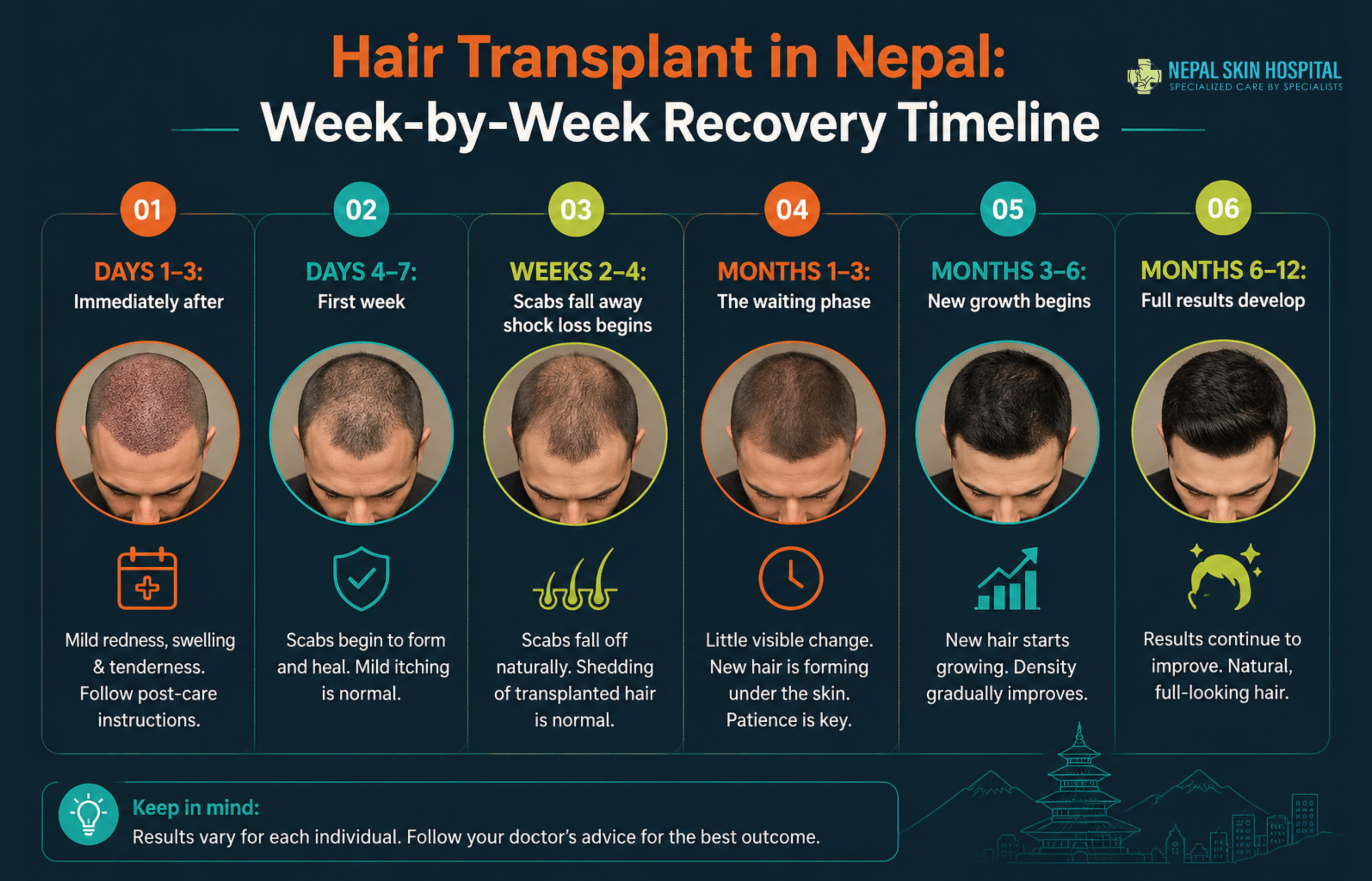
Recovery is the part of a hair transplant in Nepal that most people want to know about, and the part most clinics do not explain clearly enough. Here is an honest, week-by-week guide to what you can expect.
Days 1–3: Immediately after
You will have some mild redness, swelling, and a tight feeling in both the donor and recipient areas. This is completely normal. Tiny scabs will form around each implanted graft, do not touch, scratch, or pick at them. Sleep with your head elevated to reduce swelling. Avoid bending forward or any movement that increases blood pressure to the scalp.
Days 4–7: First week
The swelling starts to go down. Redness is still visible but fading. By day 7, most patients feel well enough to return to desk-based office work. According to a 2023 study in the Journal of Dermatologic Surgery, 87% of FUE patients reported returning to their normal routine within 10 days.
Weeks 2–4: Scabs fall away shock loss begins
The scabs naturally fall off during washing by days 10 to 14. Let them shed on their own, do not pull or pick. Around weeks 2 to 4, the transplanted hairs begin to shed. This is called shock loss. It looks alarming, but it is completely normal and expected.
According to the American Academy of Dermatology, shedding after a hair transplant is a standard, temporary part of the growth cycle. The follicles are not lost — they are simply resting before new growth begins.
Months 1–3: The waiting phase
This is the hardest part for most patients. The transplanted area looks similar to, or sometimes temporarily worse than, how it looked before the procedure. But beneath the surface, the follicles are anchoring themselves and building a blood supply. This phase is necessary. Think of it as a reset.
By month 3, the donor area is fully healed. You can return to all normal activities, including exercise, swimming, and sports.
Months 3–6: New growth begins
Around months 3 to 4, new hair starts to emerge. It begins fine, thin, and light in colour. By the 6-month mark, research published in Aesthetic Plastic Surgery shows that approximately 60% of new hair growth is visible. The transplant starts to look and feel genuinely worth it.
Months 6–12: Full results develop
This is where the transformation really happens. Between months 6 and 12, hair becomes denser, fuller, and begins to blend naturally with your existing hair. Most patients at Nepal Skin Hospital see dramatic improvement by months 8 to 12.
By 12 months, the full result is visible. Some patients continue to see subtle improvements up to 18 months after the procedure. The transplanted hair is now permanent; it will not fall out due to DHT sensitivity, the way your original hair did.
Hair Transplant in Nepal: Aftercare Tips for the Best Results
How you care for your scalp after your hair transplant in Nepal has a direct effect on your results. Follow these guidelines carefully:
Washing
- Begin gentle washing from day 3 or 4, exactly as instructed by your surgeon.
- Use only the mild, prescribed shampoo. Apply it gently with your fingertips, never rub or scrub.
- Rinse with low-pressure water. High-pressure water can dislodge grafts in the first 10 days.
- Spray normal saline on the transplanted area every hour for the first 3 days to keep grafts moist.
Lifestyle
- Avoid direct sun on the scalp for at least 4 weeks. If you must go outside, wear a loose-fitting hat, but only after the first 10 days, and only with your doctor’s approval.
- Do not exercise heavily for the first 2 weeks. Increased blood pressure and sweating can damage newly placed grafts.
- Avoid alcohol for at least 2 weeks after the procedure.
- Do not smoke during recovery. Smoking reduces blood flow to the scalp and slows healing significantly.
- Sleep with your head elevated for the first week to reduce swelling.
Nutrition
Good nutrition supports faster healing and stronger hair growth. Focus on protein-rich foods — eggs, lentils, chicken, and fish, as hair follicles need protein to grow. Zinc, iron, and vitamins A, C, and E are also important. Drink plenty of water every day.
PRP Therapy: The Ideal Complement to a Hair Transplant in Nepal
Many patients at Nepal Skin Hospital combine their hair transplant in Nepal with PRP therapy, Platelet Rich Plasma. PRP involves taking a small amount of your own blood, processing it to concentrate the growth factors, and injecting it into the scalp.
These growth factors stimulate the transplanted follicles, improve graft survival, and help existing hair grow thicker and stronger. PRP before or after a hair transplant significantly improves results, especially in the first critical months after the procedure. Ask about our mesotherapy and hair restoration services to find out if PRP is right for your treatment plan.
Frequently Asked Questions About Hair Transplant in Nepal
Is a hair transplant in Nepal permanent?
Yes. The transplanted hair follicles come from the donor area — the back and sides of your scalp, where hair is genetically resistant to DHT. This means the transplanted hair will not fall out the way your original hair did. Once the follicles have settled and grown, they are permanent for life.
Is a hair transplant in Nepal painful?
The procedure is done under local anaesthesia. You will feel a small pinch during the injections. After that, the area is completely numb, and you will not feel pain during the procedure. After the anaesthesia wears off, there may be some mild soreness and tightness for a few days, similar to a mild headache. This is easily managed and typically resolves within a week.
How much does a hair transplant in Nepal cost?
The cost of a hair transplant in Nepal is calculated per graft. The number of grafts you need depends on the size of the area being treated and the degree of hair loss. At Nepal Skin Hospital, pricing is discussed transparently during your consultation, with no hidden costs. Compared to getting the same procedure done in India, Thailand, or Turkey, having your hair transplant in Nepal at a reputable clinic offers excellent value without compromising on quality or safety.
When will I see results from my hair transplant in Nepal?
New hair begins to emerge at around 3 to 4 months. By 6 months, approximately 60% of results are visible. Full, final results are typically seen between 12 and 18 months after the procedure. Patience is essential; the results are real and worth waiting for.
Can women get a hair transplant in Nepal?
Yes. Women with female pattern hair loss, traction alopecia (hair loss from tight hairstyles), or hair loss from scarring are often good candidates for a hair transplant in Nepal. The procedure works the same way and produces equally natural results. A consultation is the best way to find out whether it is the right option for you.
What is the difference between FUE and FUT?
FUT (Follicular Unit Transplantation) involves removing a strip of scalp from the donor area, which leaves a linear scar. FUE (Follicular Unit Extraction) extracts individual follicles using a micro-punch, leaving no linear scar and allowing for faster recovery. At Nepal Skin Hospital, we use the FUE technique because it produces more natural results, causes less discomfort, and heals faster, making it the better choice for most patients.
Why Choose Nepal Skin Hospital for Your Hair Transplant in Nepal?1
There are many clinics offering hair transplants in Nepal. Here is what makes Nepal Skin Hospital different:
- Experienced dermatologists who have performed hundreds of successful FUE hair transplants in Kathmandu
- The latest precision motorised FUE equipment for maximum graft survival
- A personalised approach, every hairline is designed specifically for your face shape and goals
- Transparent pricing with no hidden costs
- Comprehensive aftercare support, you are not left to manage recovery alone
- Full range of complementary treatments, including PRP therapy, mesotherapy, and scalp care
Hair loss does not have to be permanent. A hair transplant in Nepal at Nepal Skin Hospital gives you real, lasting hair, grown from your own follicles, designed to look completely natural, and built to last a lifetime.
Final Thoughts: Is a Hair Transplant in Nepal Worth It?
Yes, for the right candidate, a hair transplant in Nepal is one of the most effective and permanent solutions to hair loss available today. It is not a quick fix. It takes patience, up to 12 months for full results. But the outcome is natural, permanent hair that you can wash, cut, and style just like it was always there.
If you have been struggling with hair loss and have tried everything else, this could be the answer you have been looking for. The first step is simple. Book a consultation with our team at Nepal Skin Hospital. We will assess your hair, answer every question you have, and tell you honestly whether a hair transplant in Nepal is right for you. Because you deserve real results, not just hope.