

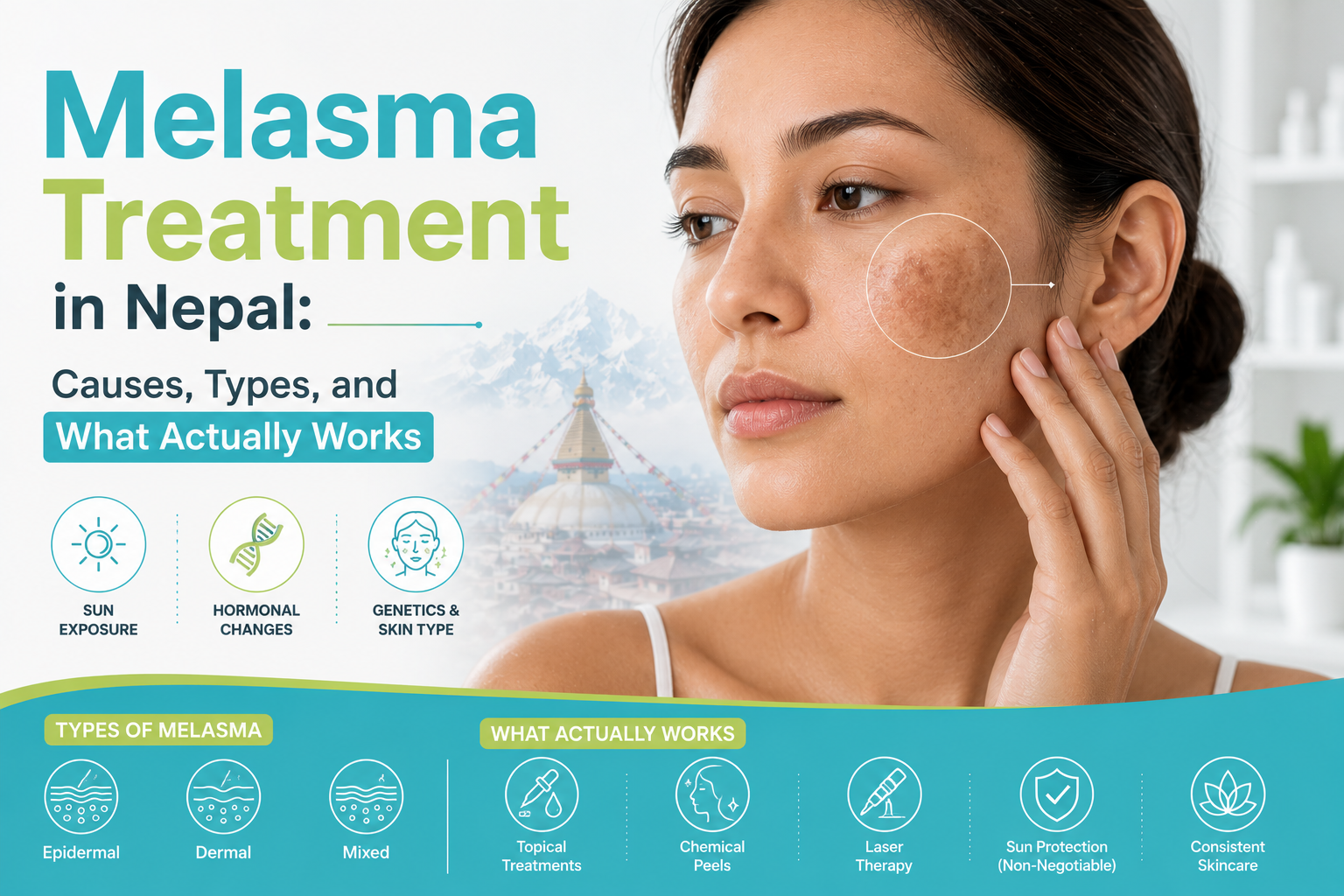
Melasma treatment in Nepal is one of the most frequently searched dermatology topics in Kathmandu and one of the most mismanaged. Millions of Nepali women recognise those familiar brown or grey patches on their cheeks, forehead, and upper lip. Many spend years trying fairness creams, home remedies, and over-the-counter lighteners without results, or worse, with serious steroid-induced side effects from unregulated creams.
The reason these approaches fail is simple: melasma is not a surface problem. It is a deep, complex pigmentation disorder driven by UV exposure, hormones, genetics, and in Nepal specifically, the high-altitude UV intensity of the Kathmandu Valley. Treating it effectively requires the right diagnosis, the right combination of treatments, and crucially the right sun protection approach to prevent it from coming straight back.
This guide covers everything you need to know about melasma treatment in Nepal: what it is, what causes it, which types respond to which treatments, and what the evidence actually says about what works. Our specialist dermatologists at Nepal Skin Hospital have been treating melasma patients in Kathmandu for over 15 years and have directly contributed to published research on the condition in Nepal.
What is melasma? Melasma, known locally in Nepal as poto or chaya poto, is a chronic skin condition that causes dark, irregular brown or grey patches on the face. It is caused by overactive melanocytes, the pigment-producing cells in the skin, and is strongly triggered by UV radiation, hormonal changes, and genetic predisposition. Melasma is not harmful, but it significantly affects confidence and quality of life.
Key statistics on melasma in Nepal: A hospital-based cross-sectional study conducted at Nepal Skin Hospital, Kathmandu (March to August 2023) involving 174 melasma patients found that 62.6% had Fitzpatrick Skin Type IV, the most common skin type in Nepal and the highest risk category for melasma. The mean MELASQoL (Melasma Quality of Life) score was 51.89, confirming significant psychosocial impact. Sunscreen was the most commonly prescribed treatment, followed by tranexamic acid, hydroquinone, chemical peels, antioxidants, multivitamins, and retinoids. A study in rural Nepal among 546 dermatological patients found melasma was the most common pigmentary disorder and the fourth most common skin diagnosis overall. Source: Wiley Dermatology Research and Practice, 2026.
Why Is Melasma So Common in Nepal?
Nepal has one of the highest rates of melasma in South Asia. This is not a coincidence; Nepal’s specific combination of environmental, hormonal, and demographic factors creates almost ideal conditions for melasma to develop and persist.
1. High-altitude UV exposure: Kathmandu sits at approximately 1,400 metres above sea level. UV radiation increases by roughly 10–12% per 1,000 metres of altitude. This means Kathmandu residents receive significantly more UV radiation than people at sea level, even on cloudy days. UV is the primary external trigger for melasma, directly stimulating melanocytes to produce excess pigment. During spring (March to May), Kathmandu’s UV Index regularly exceeds 12, classified as extreme. Read our detailed guide on sun damage and skin protection in Nepal for more.
2. Fitzpatrick Skin Types III–V: The vast majority of Nepali people have medium to dark skin tones, Fitzpatrick Types III, IV, and V. These skin types have naturally more active melanocytes that produce pigment more readily in response to UV radiation, hormones, and inflammation. According to the Nepal Skin Hospital study, 62.6% of melasma patients had Fitzpatrick Type IV skin. This is the most susceptible type for developing difficult-to-treat melasma.
3. Hormonal exposure: Pregnancy, oral contraceptive use, and hormonal fluctuations are major melasma triggers. The Nepal Skin Hospital study found that 37.9% of patients were previous OCP (oral contraceptive pill) users and 19.5% were current users at the time of their diagnosis. Additionally, more than a third of patients had experienced multiple pregnancies, another significant hormonal trigger. This is why melasma is often called the ‘mask of pregnancy’ in Nepal and is known locally as poto.
4. Inadequate sun protection: Despite extreme UV levels, consistent sunscreen use remains low in Nepal. The Nepal Skin Hospital study found that only 57.5% of melasma patients used sunscreen during sun exposure. Many patients discontinue sunscreen use during winter months, not realising that UV damage accumulates year-round. Without strict daily sun protection, melasma treatment results cannot be maintained.
5. Widespread misuse of topical steroids: A major contributing factor to difficult-to-treat melasma in Nepal is the widespread use of topical corticosteroid-containing fairness creams sold without prescription. Research published in the Journal of the Nepal Medical Association documented significant rates of steroid misuse among dermatology outpatients. Long-term steroid use initially lightens the skin but causes rebound hyperpigmentation, skin thinning, and steroid-induced melasma-like changes that are much harder to treat.
The 3 Types of Melasma in Nepal and Why It Matters
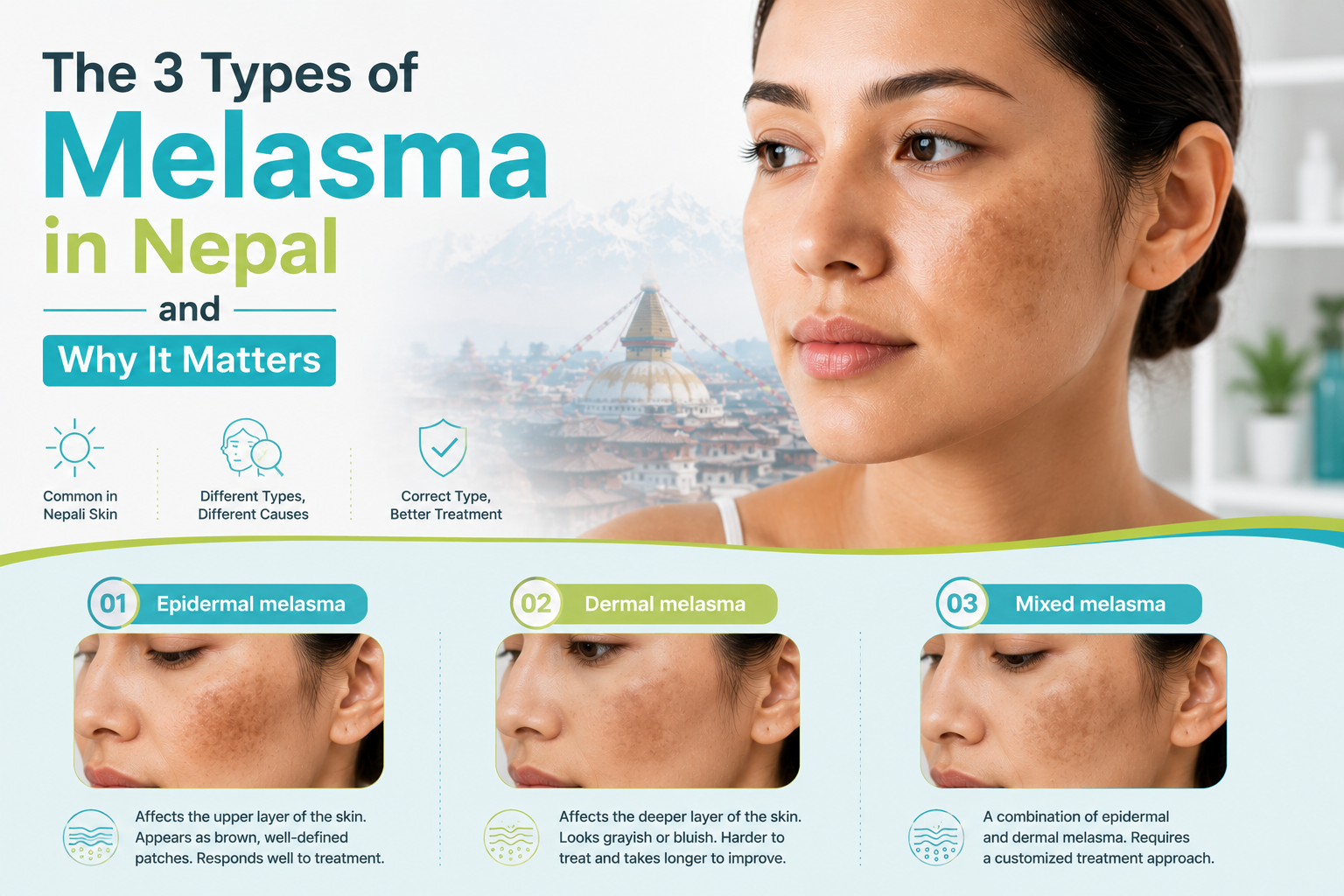
Not all melasma is the same, and this is the most important clinical distinction for determining which treatment will work. Melasma is classified by depth of pigmentation, which can be determined by Wood’s lamp examination or dermoscopy.
| Type | Depth | Wood’s Lamp | Skin Colour | Responds to Treatment? |
|---|---|---|---|---|
| Epidermal melasma | Outer skin layer (epidermis) | Becomes darker under Wood’s lamp | Brown | Best response, most treatable |
| Dermal melasma | Deeper skin layer (dermis) | No change under Wood’s lamp | Blue-grey or grey-brown | Resistant to most topical treatments |
| Mixed melasma | Both layers | Partial darkening | Brown with grey tones | Partial response needs combination therapy |
Most Nepali patients, given their Fitzpatrick Type III–V skin, tend to present with mixed or dermal melasma, which is why standard fairness creams and basic topical treatments often fail. A proper Wood’s lamp examination or dermoscopy by a qualified dermatologist is essential before starting any treatment programme.
Melasma Treatment in Nepal: What the Evidence Actually Says
The Nepal Journal of Dermatology, Venereology & Leprology (2025) published a comprehensive review of current melasma treatment options, confirming that the most effective approach combines topical agents, sun protection, and procedural treatments, with maintenance being as important as initial clearance.
A 2025 network meta-analysis published in PMC analysing 14 randomised controlled trials across 15 treatment modalities involving 738 women confirmed that combination therapy consistently outperforms any single treatment for melasma. Here is what the evidence supports:
| Treatment | Best For | Evidence Level | Available in Kathmandu? |
|---|---|---|---|
| Daily broad-spectrum SPF 50+ | All melasma types foundation of any plan | Strong essential | Yes |
| Tranexamic acid (oral + topical) | Mixed and dermal melasma, hormonal triggers | Strong well studied | Yes |
| Hydroquinone 2–4% | Epidermal melasma first-line topical | Strong gold standard | Yes (prescription only) |
| Kojic acid | Mild to moderate epidermal melasma | Moderate evidence | Yes |
| Azelaic acid | Sensitive skin, pregnancy-safe option | Moderate evidence | Yes |
| Retinoids (tretinoin) | Epidermal melasma speeds cell turnover | Strongly enhances other treatments | Yes (prescription only) |
| Chemical peeling (glycolic/TCA) | Epidermal and mixed melasma | Strongly widely used in Nepal | Yes, Nepal Skin Hospital |
| Fractional non-ablative laser | Resistant mixed/dermal melasma | Moderate FDA-approved for melasma | Yes, Nepal Skin Hospital |
| PRP microneedling | Resistant melasma emerging therapy | Emerging Tribhuvan University study 2025 | Yes, Nepal Skin Hospital |
| Oral antioxidants (Vit C, E, glutathione) | Adjunct therapy supports other treatments | Supportive evidence | Yes |
Step-by-Step: How Melasma Treatment in Nepal Is Approached at Nepal Skin Hospital
Effective melasma treatment in Nepal follows a structured, stepwise protocol. This is not a single-session fix. It requires patience, consistency, and a combination of daily habits and professional treatments. Here is exactly how our team at Nepal Skin Hospital approaches melasma:
- Accurate diagnosis, Wood’s lamp examination and/or dermoscopy to determine melasma depth (epidermal, dermal, or mixed). This determines which treatments will be effective.
- Trigger identification, reviewing sun exposure habits, hormonal history (pregnancy, OCP use), medications, and skincare products that may be worsening the condition.
- Daily SPF 50+ sunscreen, the absolute foundation. No treatment works without strict, daily broad-spectrum sun protection. This must be applied every morning and reapplied every 2 hours outdoors. Without this, melasma will return regardless of other treatments.
- Targeted topical regimen, a customised combination of tranexamic acid, hydroquinone, azelaic acid, and/or retinoids depending on the melasma type and skin sensitivity.
- Professional procedural treatment, chemical peeling, laser therapy, or PRP microneedling sessions spaced 3 to 4 weeks apart, adjusted based on treatment response and skin tolerance.
- Maintenance phase, after initial clearance, ongoing monthly treatments, consistent sun protection, and topical maintenance agents to prevent relapse.
Important: Melasma is a chronic, relapsing condition. Even after successful treatment, it can return with UV exposure, hormonal changes, or stress. The Nepal Skin Hospital study found that 44.8% of patients had melasma lasting 14 months or longer, confirming that long-term management is essential, not just short-term clearing.
Chemical Peeling for Melasma Treatment in Nepal
Chemical peeling is one of the most effective and most accessible professional treatments for melasma treatment in Nepal. It involves applying a precisely calibrated chemical solution to the skin surface that safely removes the outer layers where excess pigment is concentrated, triggering the growth of fresh, evenly pigmented skin underneath.
At Nepal Skin Hospital, we use several types of chemical peel for melasma depending on the skin type and melasma depth:
- Glycolic acid peels (20–70%), for mild to moderate epidermal melasma. Suitable for Fitzpatrick Type III–IV skin.
- Salicylic acid peels, particularly useful when melasma is accompanied by acne or oily skin.
- Mandelic acid peels, slower-acting but gentler for sensitive darker skin types. Excellent for Nepali patients with Type IV–V skin.
- TCA (trichloroacetic acid) peels, for moderate to deep melasma. Requires expert application to avoid post-inflammatory hyperpigmentation in darker skin.
A series of 4 to 6 chemical peeling sessions, spaced 3 to 4 weeks apart, produces the best results for melasma. Learn more about our chemical peeling treatments at Nepal Skin Hospital.
Laser Treatment for Melasma in Kathmandu
Laser treatment for melasma must be approached with significant caution in Nepal, particularly for patients with Fitzpatrick Type IV–V skin. Aggressive laser protocols can worsen melasma by causing post-inflammatory hyperpigmentation, which is darker and harder to treat than the original condition. This is why choosing an experienced dermatologist is critical.
The fractional non-ablative laser is the only laser modality currently supported by strong evidence for melasma. It delivers controlled micro-injuries to the skin, stimulating collagen and cell renewal without the aggressive surface ablation that triggers pigmentation in darker skin types. A 2026 review in the Journal of Cosmetic Dermatology (PMC) confirmed fractional non-ablative laser as one of the leading innovations in melasma management, particularly when combined with topical tranexamic acid.
Our full guide to laser treatments available in Kathmandu explains which laser options are available at Nepal Skin Hospital and how they are selected for individual patients.
PRP Therapy for Melasma New Research from Nepal
A 2025 clinical study conducted at Tribhuvan University Teaching Hospital, Kathmandu, published in the Journal of Cosmetic Dermatology, investigated the efficacy of PRP (Platelet Rich Plasma) therapy for melasma delivered by two techniques: microneedling versus microinjection. The study found that PRP therapy produced meaningful improvements in melasma severity scores in both delivery methods, with microneedling showing particularly good results.
PRP uses your own blood, processed to concentrate growth factors, to reduce inflammation in the melanocytes, improve skin barrier function, and suppress excessive pigment production. For patients whose melasma has not responded adequately to topical treatments and chemical peeling, PRP represents a valuable next step in the treatment ladder. It is particularly safe for darker Fitzpatrick skin types because it uses the body’s own biological material with no risk of thermal damage or chemical irritation.
What Not to Do: Common Melasma Mistakes in Nepal
These are the most frequent errors that make melasma worse in Nepal, and why each is harmful:
- Using fairness creams and whitening products without dermatologist supervision: Many available over the counter in Nepal contain undisclosed corticosteroids, mercury, or hydroquinone at unsafe concentrations. Short-term lightening followed by severe rebound darkening is extremely common. Nepal Medical Association research documented significant steroid misuse rates among dermatology patients.
- Skipping or inconsistently applying sunscreen: The single biggest cause of treatment failure and relapse in Nepal. Sunscreen must be applied every day, not just in summer, not just when it is sunny, because UV radiation causes melasma year-round, including on overcast days in Kathmandu.
- Using a single treatment approach: Monotherapy rarely works for melasma. The PMC meta-analysis of 14 RCTs confirmed that combination therapy consistently outperforms any single treatment. Topical agents + sun protection + procedural treatment is the evidence-based standard.
- Expecting immediate results: Melasma responds slowly. Even with the best treatment plan, visible improvement typically takes 3 to 12 months. Impatience leads patients to abandon effective plans prematurely or switch to aggressive treatments that cause more harm.
- Waxing the face: Waxing causes skin inflammation, which directly stimulates melanocytes to produce more pigment. Patients with melasma should avoid facial waxing entirely and use threading or laser hair removal instead.
- Stopping treatment after improvement: Melasma is a chronic condition. Stopping all treatment after clearing typically results in relapse, particularly in Nepal’s high-UV environment. A maintenance plan must be in place.
Frequently Asked Questions About Melasma Treatment in Nepal
What is melasma called in Nepali?
Melasma is commonly called ‘poto’ or ‘chaya poto’ in Nepali. The term describes the dark shadow-like patches that appear on the face. It is one of the most common skin complaints among Nepali women aged 20 to 50, particularly in Kathmandu and other urban areas with high UV exposure.
How much does melasma treatment cost in Nepal?
Melasma treatment costs in Nepal depend on the type of treatment and number of sessions required. A dermatologist consultation typically starts at NPR 500 to 1,500. Topical prescription creams range from NPR 1,200 to 2,500 per course. Chemical peeling sessions at qualified clinics in Kathmandu range from approximately NPR 2,000 to 5,000 per session. Laser treatment costs are higher and vary by clinic and number of sessions. At Nepal Skin Hospital, pricing is discussed transparently during your initial consultation with no hidden costs.
Can melasma be permanently cured?
Melasma cannot be permanently cured in the conventional sense, because its underlying triggers (UV exposure, hormonal activity, and genetic predisposition) continue to be present. However, with the right combination of treatments and diligent daily sun protection, melasma can be very effectively managed and kept visually clear. Many patients at Nepal Skin Hospital achieve excellent, long-lasting results. The key is ongoing maintenance and strict sun protection throughout the year.
Is chemical peeling safe for dark skin in Nepal?
Yes, when performed by an experienced dermatologist using the correct peel type and concentration for your skin tone. At Nepal Skin Hospital, our dermatologists select peels specifically suited for Fitzpatrick Type III–V skin, which is the predominant skin type among Nepali patients. We use gentler acid formulations like mandelic acid and low-concentration glycolic acid for darker skin to minimise the risk of post-inflammatory hyperpigmentation.
Why does my melasma keep coming back after treatment?
Relapse is the most common challenge with melasma treatment in Nepal. The most frequent reasons are: insufficient or inconsistent sunscreen use (UV is the primary trigger for recurrence), hormonal changes (pregnancy, starting or stopping contraceptives), and stopping maintenance treatments too soon. Melasma requires a long-term management mindset, not a once-and-done treatment. Our dermatologists will build a personalised maintenance plan to keep your results lasting.
Can men get melasma in Nepal?
Yes. Although melasma is significantly more common in women, primarily due to hormonal triggers, men are also affected. A study conducted at Nepal Medical College found that melasma affected both males and females across the 20 to 50 age group. In men, UV exposure and genetic predisposition are the primary drivers rather than hormonal triggers. Treatment approaches are generally the same.
When to See a Dermatologist for Melasma in Kathmandu
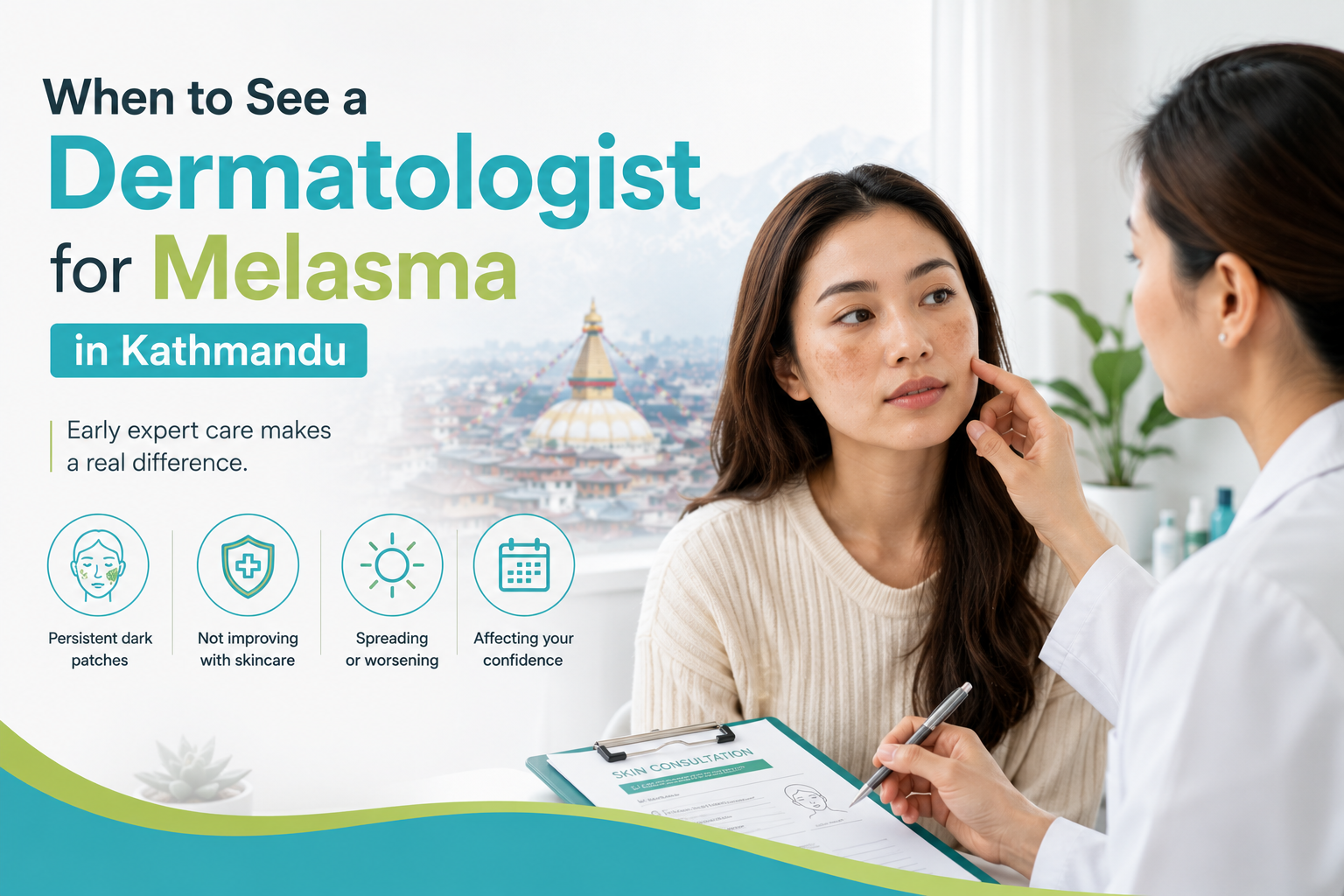
You should seek professional assessment for melasma treatment in Nepal if:
- You have had dark patches on your face for more than 3 months that have not responded to basic skincare.
- You have been using over-the-counter whitening or fairness creams for more than 4 weeks without improvement, or if your skin has become thinner, redder, or developed acne-like bumps (signs of steroid-related side effects).
- You are pregnant or breastfeeding and need a treatment plan that is safe for both you and your baby.
- Your melasma is affecting your confidence, emotional wellbeing, or daily life.
- You want to understand whether your melasma is epidermal, dermal, or mixed, and which specific treatments are most likely to work for your type.
Our experienced dermatologists at Nepal Skin Hospital will conduct a full skin assessment including Wood’s lamp examination, review your history and current triggers, and build a personalised melasma treatment plan for your skin type and lifestyle in Kathmandu.
Final Thoughts: Melasma Treatment in Nepal Is Possible With the Right Approach
Melasma is one of the most common, most frustrating, and most mismanaged skin conditions in Nepal. But it is also one of the most treatable, when approached correctly. The evidence is clear: combination therapy, strict daily sun protection, and patient maintenance produce real, lasting results for Nepali patients of all ages.
Stop wasting time and money on fairness creams that do not work or, worse, cause steroid damage that makes your skin harder to treat. Get a proper diagnosis. Find out what type of melasma you have. Start a treatment plan that is built on evidence, not marketing.
Nepal Skin Hospital has been at the centre of melasma research and treatment in Kathmandu for over 15 years, and our team’s work has been published in peer-reviewed journals. We understand what works for Nepali skin in Nepal’s environment. Book your consultation today, and take the first real step toward clearer, more even skin.