

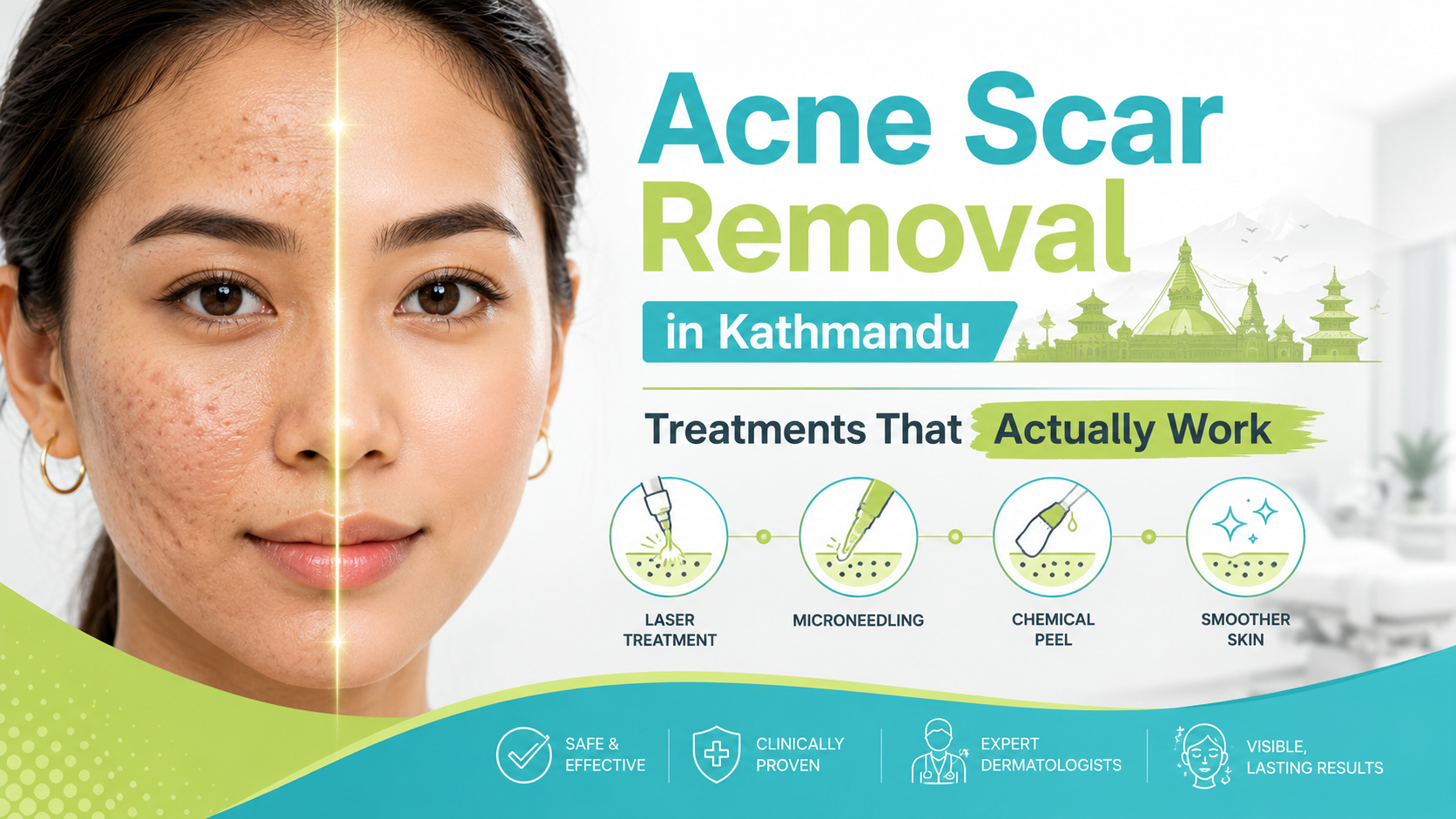
Acne scar removal in Kathmandu is now more effective than ever. Gone are the days when acne scars were something you just had to live with. Today, professional dermatological treatments available right here in Kathmandu can dramatically reduce, and in many cases nearly eliminate, even deep, stubborn acne scars.
If you have acne scars, you are not alone. Research published in Springer’s dermatology reference confirms that more than 80% of people who have had acne will develop some degree of scarring. In Nepal, where acne is extremely common, worsened by Kathmandu’s heat, pollution, and humidity, acne scars affect a huge number of people of all ages.
The problem is that many people in Nepal try home remedies, fairness creams, or random products for years without seeing real results. That is because acne scars are not a surface issue. They involve structural damage deep inside the skin. They need proper, targeted treatment. Our skin specialists at Nepal Skin Hospital offer the most advanced acne scar removal in Kathmandu, tailored to your exact scar type and skin tone.
Why Do Acne Scars Form in the First Place?
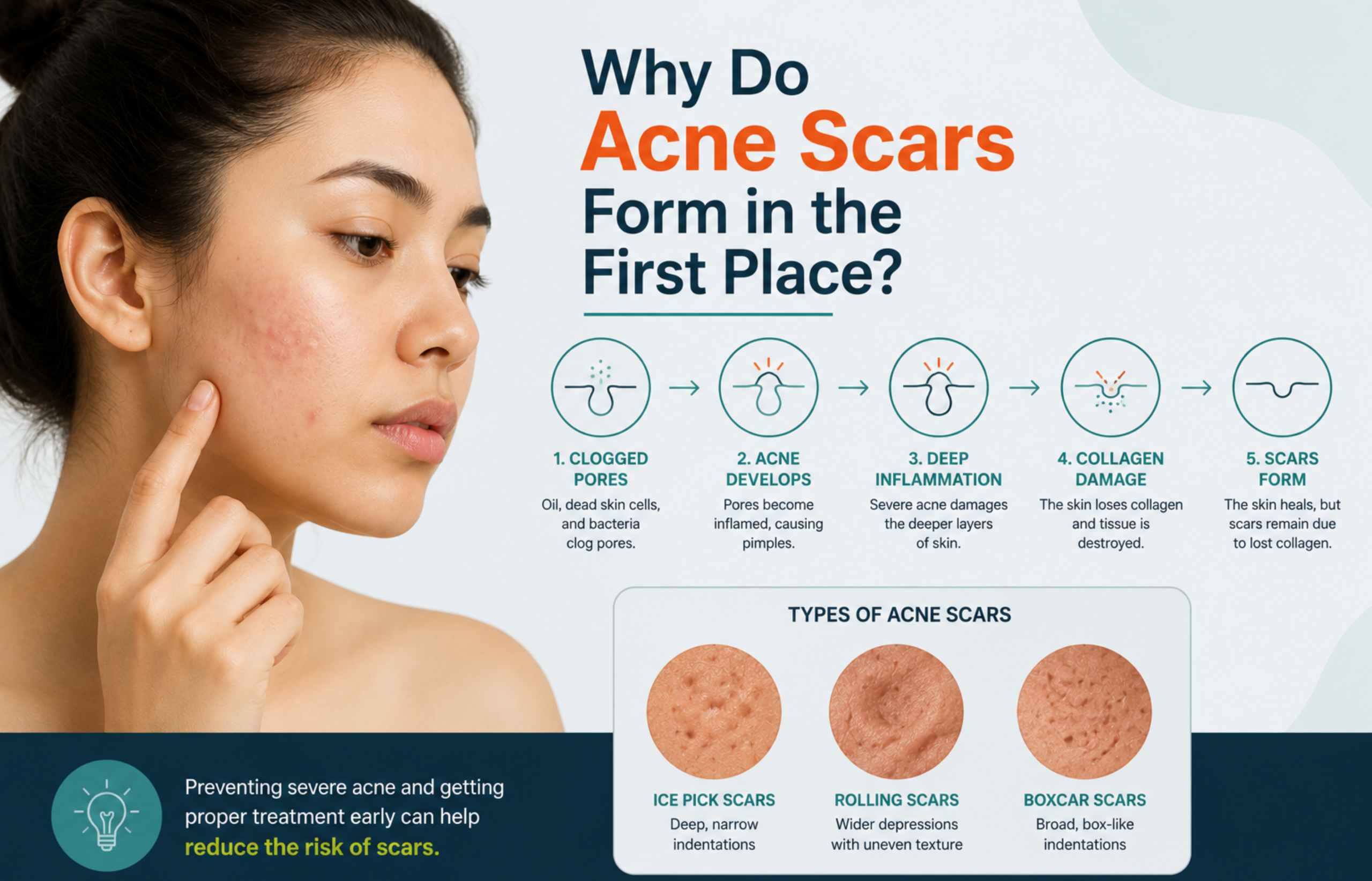
Before looking at acne scar removal in Kathmandu, it helps to understand why scars form. When a pimple becomes inflamed, especially a deep nodule or cyst, it damages the surrounding skin tissue. As the skin heals, it produces collagen to repair the damage. But it does not always produce the right amount.
- If too little collagen is produced, the skin heals with a depression or indentation, an atrophic scar.
- If too much collagen is produced, the skin heals with a raised, thickened lump, a hypertrophic scar or a keloid.
This is why picking and squeezing pimples makes scarring so much worse. It increases inflammation, damages more tissue, and forces the skin to repair a much larger wound. If you are still dealing with active acne alongside scarring, read our guide on how to treat acne at every age, because preventing new breakouts is the first step to preventing new scars.
The 4 Main Types of Acne Scars, and Why It Matters for Treatment
This is the most important thing to understand about acne scar removal in Kathmandu: not all acne scars are the same. Each type requires a different treatment approach. Using the wrong treatment for your scar type wastes money and time, and sometimes makes things worse.
According to a comprehensive review published in PMC, the National Library of Medicine, acne scars fall into two main categories: atrophic (depressed) and hypertrophic (raised). Within these, there are four main types:
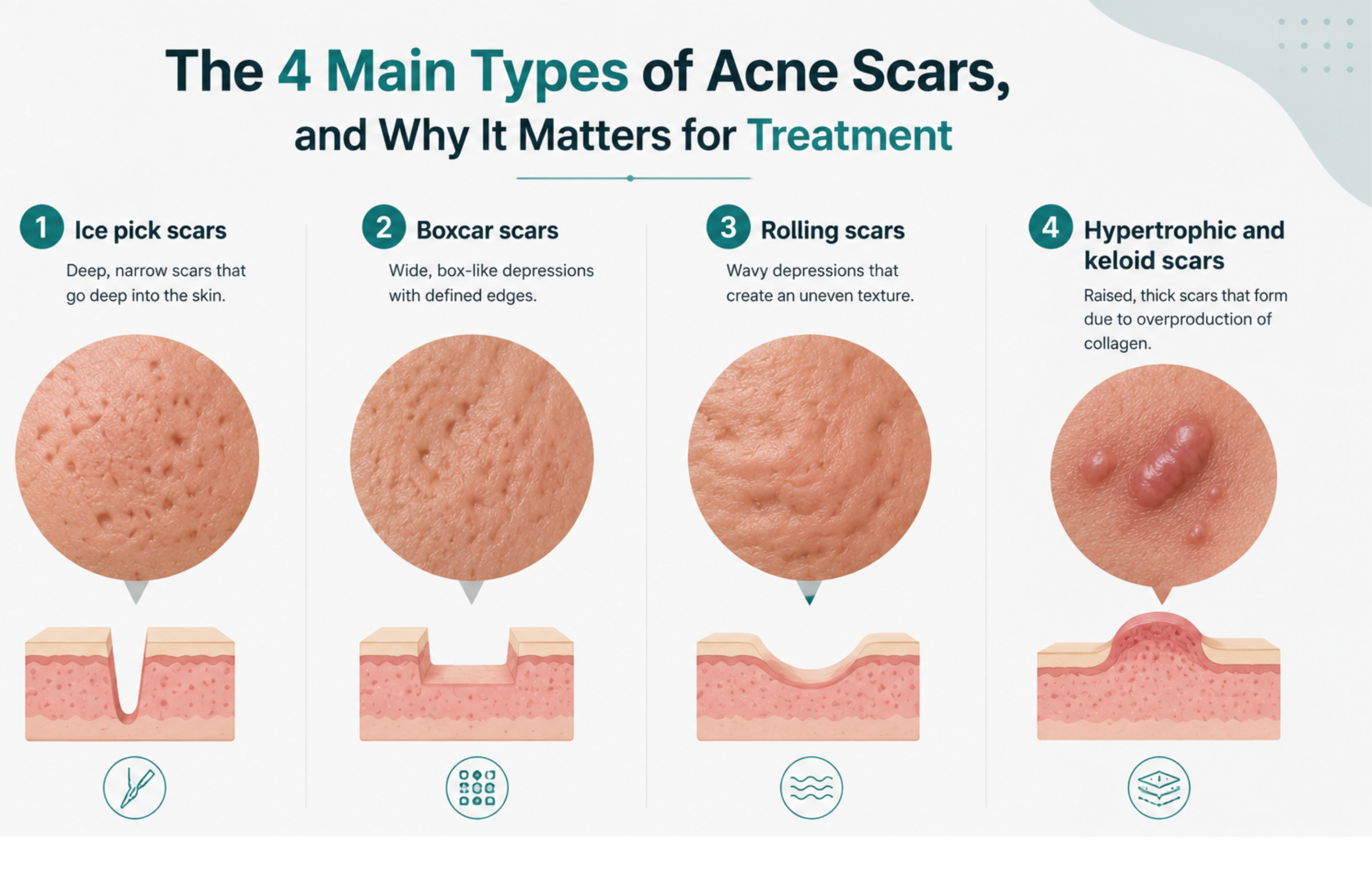
1. Ice pick scars
Ice pick scars are deep, narrow, and sharp, like tiny holes or punctures in the skin. They are the most common type of acne scar. They extend deep into the dermis, which makes them the hardest to treat. They do not respond well to most surface treatments. They need targeted approaches like TCA CROSS or fractional CO2 laser to reach and remodel the deeper skin tissue.
2. Boxcar scars
Boxcar scars are round or oval depressions with sharp, clearly defined edges. They are wider than ice pick scars and can be shallow or deep. Shallow boxcar scars respond well to chemical peeling and microneedling. Deeper boxcar scars often need fractional laser treatment or a combination approach for the best results.
3. Rolling scars
Rolling scars create a wave-like, uneven texture across the skin. They are caused by fibrous bands of tissue that pull the skin surface downward. They give the face a rough, bumpy appearance that can look worse in certain lighting. Rolling scars respond especially well to subcision, a technique that releases the fibrous bands, combined with microneedling or dermal fillers.
4. Hypertrophic and keloid scars
Unlike the first three types, hypertrophic scars and keloids are raised above the skin surface. They occur when the body overproduces collagen during healing. Hypertrophic scars stay within the boundary of the original wound. Keloid scars spread beyond it. Both types require very different treatment, typically steroid injections, laser therapy, or a combination, rather than the resurfacing techniques used for atrophic scars.
Not sure which type of scar you have? Our experienced dermatologists will assess your scars precisely and recommend the most effective treatment plan for your skin type.
Acne Scar Removal in Kathmandu: The Best Treatments Available
Nepal Skin Hospital offers a full range of professional acne scar removal treatments in Kathmandu. Here is an honest breakdown of each one, what it does, who it works best for, and what to expect.
1. Chemical peeling
Chemical peeling is one of the most widely used and effective treatments for acne scar removal in Kathmandu. It uses carefully selected acids to remove the damaged outer layers of skin. This triggers the skin’s natural repair process, stimulating fresh collagen production and revealing smoother, clearer skin underneath.
Different strengths of chemical peel work for different types of scars:
- Superficial peels (glycolic acid, salicylic acid) are best for mild surface scarring and post-acne dark marks.
- Medium-depth peels (TCA) effective for moderate boxcar and rolling scars, as well as post-inflammatory hyperpigmentation.
- TCA CROSS. a specialised technique using high-concentration TCA applied directly into ice pick scars. It triggers localised collagen production inside the scar, gradually raising it to skin level.
A 2025 meta-analysis published in PMC found that combining chemical peeling with microneedling produces significantly better results than either treatment alone, making it a popular combined approach for acne scar removal in Kathmandu. For a series of 4 to 6 sessions spaced 3 to 4 weeks apart, results are typically excellent. Find out more about our chemical peeling treatment at Nepal Skin Hospital.
2. Laser treatment
Laser treatment is the most powerful option for acne scar removal in Kathmandu, particularly for deep, stubborn scars that do not respond adequately to peels or microneedling alone. Laser energy works by precisely targeting and remodelling damaged skin tissue, stimulating strong collagen production and resurfacing the skin from within.
There are two main types used for acne scars:
- The fractional CO2 laser is the gold standard for acne scar removal. It removes tiny columns of damaged skin tissue while leaving surrounding tissue intact, allowing for fast healing and dramatic improvement. According to a study in Skin Therapy Letter, high-energy pulsed CO2 laser achieved up to 75% improvement in atrophic facial scars.
- Non-ablative fractional laser stimulates collagen production without removing skin tissue. Less downtime than the CO2 laser, but generally produces more gradual, modest improvements. Better suited for mild to moderate scarring or for patients who cannot afford downtime.
Explore our full range of laser treatment options in Kathmandu to find out which approach is best for your skin.
3. Microneedling (Collagen Induction Therapy)
Microneedling, also called collagen induction therapy, uses a device with fine needles to create controlled micro-injuries in the skin. This triggers the skin’s natural healing response, stimulating new collagen and elastin production. The result is smoother, firmer skin with visibly reduced scar depth.
Microneedling is particularly effective for rolling and shallow boxcar scars. It is also one of the safest options for darker Nepali skin tones; unlike some laser treatments, it does not carry a significant risk of post-inflammatory hyperpigmentation in people with more melanin. Furthermore, microneedling can be combined with PRP (Platelet Rich Plasma) therapy for significantly enhanced results.
According to research from Frontiers in Medicine 2025, fractional radiofrequency microneedling, which adds targeted thermal energy to standard microneedling, drives three key mechanisms of scar remodelling simultaneously, making it one of the most advanced and effective approaches currently available.
4. Subcision
Subcision is a minor surgical technique specifically designed for rolling acne scars. A fine needle is inserted beneath the scar and used to break the fibrous bands that are pulling the skin surface downward. Once these bands are released, the skin lifts and the rolling depression becomes much less visible.
Subcision is often combined with dermal fillers injected into the treated area to provide volume and support, or with microneedling for a comprehensive approach. This combination consistently produces excellent results for rolling scars that have not responded to surface treatments alone.
5. Dermal fillers
Dermal fillers can provide immediate improvement for rolling and boxcar acne scars. Hyaluronic acid or other filler materials are injected beneath the scar to lift the depressed area and restore volume. Results are visible immediately and can last from 6 to 18 months, depending on the filler used.
Fillers are not a permanent solution; they require maintenance. However, they are an excellent option for patients who want visible improvement quickly, or as a complement to other longer-term scar treatments.
6. PRP therapy for acne scars
PRP Platelet Rich Plasma, uses your own blood to stimulate skin healing. A small blood sample is taken, processed to concentrate the growth factors, and injected into scarred areas. These growth factors stimulate collagen production and speed up the skin’s natural repair process.
PRP is most effective when combined with other treatments, particularly microneedling or laser therapy. It improves healing, enhances results, and reduces recovery time. It is especially beneficial for patients with darker skin tones who need a gentle but effective approach. Ask about our full range of skin treatment services, including PRP therapy at Nepal Skin Hospital.
Which Acne Scar Removal Treatment in Kathmandu Is Right for You?
There is no single best treatment for every patient. The right choice depends on your scar type, your skin tone, the severity of scarring, and your lifestyle. Here is a simple guide:
- Ice pick scars → TCA CROSS + fractional CO2 laser
- Shallow boxcar scars → Chemical peeling + microneedling
- Deep boxcar scars → Fractional CO2 laser + subcision
- Rolling scars → Subcision + microneedling + dermal fillers
- Hypertrophic/keloid scars → Steroid injections + targeted laser
- Post-acne dark marks → Chemical peeling + sun protection
- Mixed scar types (most common) → Combination approach customised by a dermatologist
The most important step is a proper skin assessment. Book a consultation at Nepal Skin Hospital and our dermatologists will assess your exact scar types and recommend a personalised treatment plan, no guesswork, no one-size-fits-all approach.
How Many Sessions of Acne Scar Removal in Kathmandu Will You Need?
This is one of the most common questions, and the honest answer is: it depends on your scar type and severity. Here is a realistic expectation guide:
- Mild surface scarring and post-acne marks, 3 to 4 sessions of chemical peeling or microneedling, spaced 3 to 4 weeks apart.
- Moderate boxcar and rolling scars, 4 to 6 sessions of combined treatment. Results build progressively over 3 to 6 months.
- Deep ice pick or severe atrophic scars, 5 to 8 sessions with combination therapy including laser. Full results at 9 to 12 months.
- Hypertrophic scars, 3 to 6 monthly sessions, depending on response to treatment.
Patience is important. Acne scar removal in Kathmandu is a process, not a single event. Each treatment session triggers the skin’s repair process, which then continues working between sessions. The results are real and cumulative.
What to Do Before and After Acne Scar Removal in Kathmandu
Before your treatment
- Avoid sun exposure for at least 2 weeks before any treatment. Sun-damaged skin is more reactive and heals more slowly.
- Stop using retinoid creams or any strong active ingredients 5 to 7 days before treatment unless your dermatologist advises otherwise.
- Do not schedule treatments during or immediately before your menstrual period, as skin sensitivity increases at this time.
- Stay well hydrated in the days leading up to treatment.
- Inform your dermatologist of any medications you are taking, as some increase skin sensitivity or affect healing.
After your treatment
- Apply sunscreen SPF 50 every single day without exception. UV exposure after scar treatment dramatically increases the risk of post-inflammatory hyperpigmentation, especially in darker Nepali skin tones.
- Keep the skin clean and well moisturised. Use only the gentle, prescribed products recommended by your dermatologist.
- Do not pick at any scabbing, peeling, or flaking. This is new skin forming, and interfering with it worsens results.
- Avoid heat saunas, steam rooms, and heavy exercise for 48 to 72 hours after treatment.
- Attend all follow-up appointments. Post-treatment review allows your dermatologist to monitor your progress and adjust the plan if needed.
Why Acne Scars Are Harder to Treat in Kathmandu and What to Do About It
People in Kathmandu face specific challenges with acne scar removal that are worth understanding. First, Kathmandu’s intense UV levels are significantly higher than sea level due to the city’s altitude, making post-treatment sun sensitivity a major concern. After any laser or chemical peel treatment, the skin is particularly vulnerable to UV damage. Without strict sun protection, dark marks can develop where the scar used to be, trading one problem for another.
Second, Kathmandu’s pollution adds a layer of difficulty. Pollution particles generate free radicals that slow healing and increase inflammation. This makes consistent aftercare, including thorough daily cleansing and antioxidant-rich skincare, especially important after acne scar treatments.
Third, many Nepali patients have Fitzpatrick skin types IV to VI, medium to dark skin tones. These skin tones are at higher risk of post-inflammatory hyperpigmentation from aggressive treatments. This does not mean stronger treatments cannot be used; it means they must be administered by an experienced dermatologist who knows how to adapt techniques for darker skin. At Nepal Skin Hospital, our dermatologists have extensive experience treating all Nepali skin tones safely and effectively.
Frequently Asked Questions About Acne Scar Removal in Kathmandu
Can acne scars be completely removed?
Significant improvement, in most cases, a 60 to 80% reduction in scar visibility is achievable with the right treatments. Complete elimination of every scar is not always possible, particularly for very deep or long-standing scars. However, the improvement from professional acne scar removal in Kathmandu is typically dramatic enough to restore confidence and significantly change the way skin looks and feels.
Is acne scar removal in Kathmandu painful?
Most treatments are very well tolerated. Chemical peels produce a mild tingling or warmth. Microneedling causes minor pricking sensations. Laser treatments are performed after applying a numbing cream, so discomfort is minimal. Subcision uses local anaesthesia, making the procedure essentially painless. Your dermatologist will always prioritise your comfort throughout.
How long do results last?
Results from structural treatments such as laser resurfacing, subcision, and microneedling are permanent. The scar tissue is remodelled, and the new collagen produced is long-lasting. However, it is important to note that acne scar removal treats existing scars. If new breakouts occur, new scars can form. This is why treating active acne alongside scar treatment is so important.
Is acne scar treatment safe for dark skin in Nepal?
Yes, when performed by an experienced dermatologist using the right techniques for your skin tone. Microneedling, TCA CROSS, and carefully selected chemical peels are all safe for darker skin tones. Ablative laser treatments require a more cautious approach in darker skin, but with proper preparation and post-treatment care, they can be used very safely. Our team will always choose the safest, most effective approach for your individual skin type.
Can I get acne scar treatment if I still have active acne?
Active acne should ideally be controlled before starting scar treatment. Treating scars while new breakouts are occurring means new scars may form alongside the ones being treated, making progress difficult to measure and sustain. Your dermatologist may recommend treating your active acne first, then moving to scar treatment once breakouts are under control.
Final Thoughts: Acne Scar Removal in Kathmandu Is Worth It
Acne scars do not have to define how you look or how you feel about your skin. Acne scar removal in Kathmandu has transformed the lives of thousands of patients — restoring smoother skin, rebuilding confidence, and finally closing the chapter on years of frustrating breakouts.
The key is getting the right treatment for the right scar type delivered by an experienced team that understands Nepali skin. At Nepal Skin Hospital, that is exactly what we offer. From chemical peeling and laser treatments to microneedling, subcision, and PRP therapy, we have the full range of tools needed to give you real, lasting results.
You do not have to keep covering your scars or waiting for them to fade on their own. They will not. But with the right professional care, your skin can look and feel genuinely different. Book your consultation with our team at Nepal Skin Hospital today. Your clearer skin starts here.