


Vitiligo treatment in Nepal is a topic that deserves far more awareness than it currently receives. Across Nepal, in Kathmandu, Lalitpur, Bhaktapur, Pokhara, and beyond, thousands of people are living with the white patches of vitiligo, many of them suffering in silence because of deep-rooted social stigma, cultural misconceptions, and a widespread belief that vitiligo is untreatable.
Both of these beliefs are wrong. Vitiligo is not a curse, a sign of impurity, or divine punishment. And it is not untreatable. With modern dermatological care, including narrowband UVB phototherapy, JAK inhibitor medications, targeted immunotherapy, and melanocyte transplantation, vitiligo can be significantly managed. In many patients, especially those diagnosed early, substantial repigmentation is achievable.
This guide explains exactly what vitiligo is, why it happens, how it is diagnosed, what treatments are available at Nepal Skin Hospital in Kathmandu, and, crucially, what the latest research says about managing it effectively in Nepal’s specific environment. Our skin specialists have been treating vitiligo in Kathmandu for over 15 years and understand the unique challenges it presents for Nepali patients.
What is vitiligo? Vitiligo, called ‘safed daag’ or ‘leucoderma’ in Nepal, is a chronic autoimmune skin condition where the immune system mistakenly destroys melanocytes, the cells responsible for producing skin pigment (melanin). This creates white or depigmented patches on the skin that can appear anywhere on the body. Vitiligo is not contagious, not caused by poor hygiene, and not life-threatening, but in Nepal’s cultural context, it carries significant social stigma that deeply affects quality of life.
Key statistics on vitiligo in Nepal and globally
- The Lancet Public Health (2024) estimated global vitiligo prevalence at 0.67% among adults and 0.24% among children, affecting approximately 37 million adults and 5.8 million children worldwide.
- In South Asia, including Nepal, prevalence rates are significantly higher; community surveys in India report rates up to 8–9%, compared with 0.5–1% in Europe and North America.
- A Nepal-specific quality of life study on vitiligo found that patients experience profound psychosocial impacts, with social stigma, marriage difficulties, and reduced self-esteem being the most commonly reported concerns among Nepali vitiligo patients. Source: PubMed Impact of Vitiligo on QoL in a Nepalese Population
- A 2025 PMC study found that 28.8% of vitiligo patients experience anxiety and 24.5% experience depression, significantly higher than the general population.
- Darker skin increases the visual contrast of vitiligo patches, meaning Nepali patients with Fitzpatrick Types III–V skin often experience greater visibility of lesions and higher psychosocial burden than patients with lighter skin tones. Source: ScienceDirect Vitiligo and Depression in South Asia 2025
Why Vitiligo Carries Such Heavy Stigma in Nepal
Understanding the stigma around vitiligo in Nepal is essential because it is one of the most significant barriers to patients seeking timely treatment. Unlike in Western countries where vitiligo is primarily viewed as a cosmetic concern, in Nepal, as across South Asia, it carries deep cultural weight.
Historical and religious beliefs have long linked skin whitening or discolouration to impurity, contagion, or spiritual punishment, despite all of these beliefs being medically and scientifically false. As a result, many Nepali families conceal vitiligo from relatives and communities. Patients, particularly young women, report difficulties in marriage prospects, social isolation, school and workplace discrimination, and lasting damage to self-esteem.
The 2024 Wiley JDDG study on vitiligo stigmatisation confirmed that stigmatisation is the most common psychosocial burden among vitiligo patients globally, with Nepal specifically identified as a country where stigma is particularly pronounced. The same research confirmed that stigma directly causes anxiety, depression, and in some cases suicidal ideation.
The truth about vitiligo in Nepal: Vitiligo is an autoimmune condition, the immune system attacking the body’s own melanocytes. It is caused by a combination of genetic predisposition, immune dysfunction, and environmental triggers. It is not caused by food, diet, contact with others, karma, or divine punishment. It cannot be ‘caught’. You cannot give it to another person by touching them.
The 2 Main Types of Vitiligo Treated in Nepal
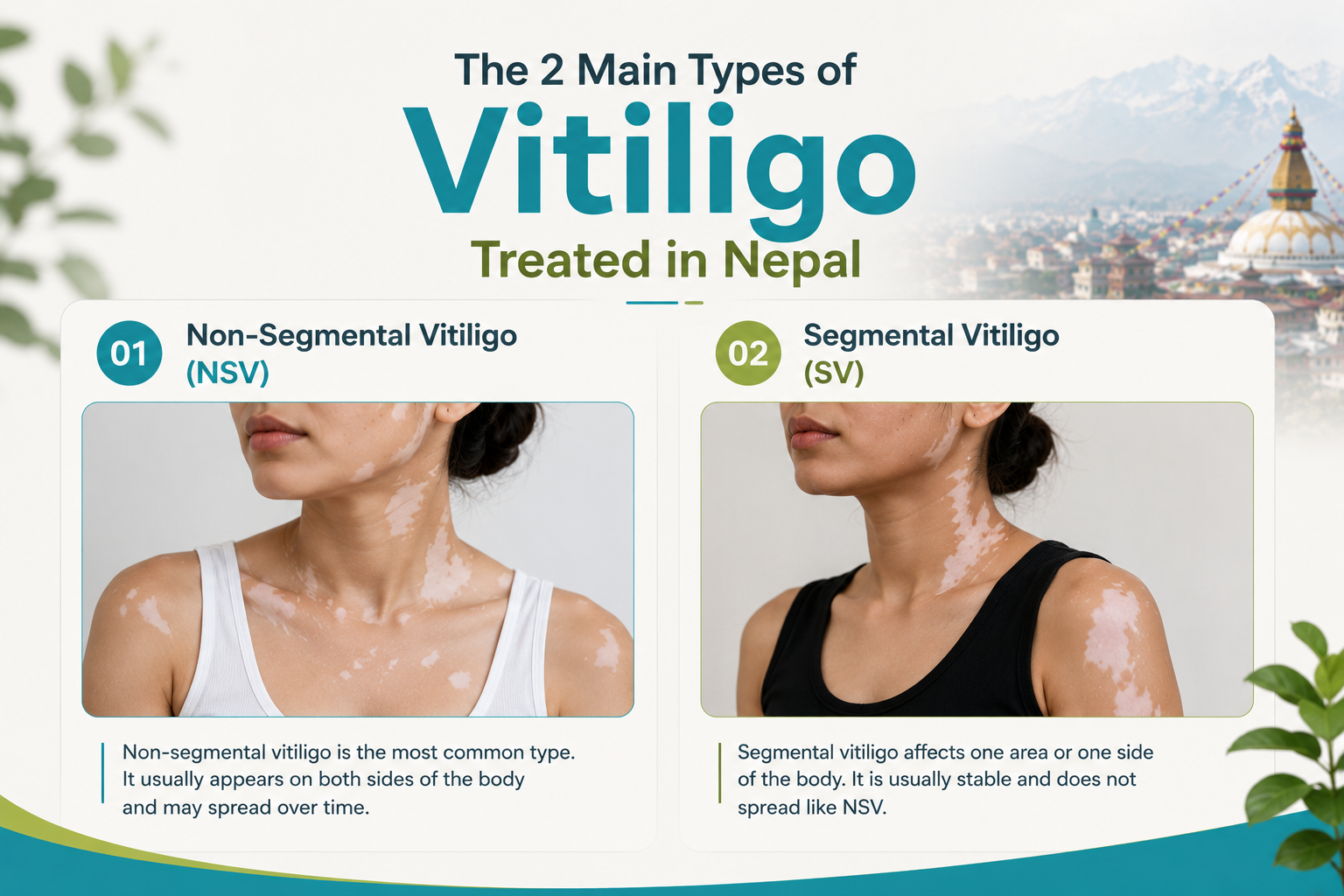
Accurate classification of vitiligo type is the foundation of effective vitiligo treatment in Nepal, because each type behaves differently, responds to different treatments, and has a different prognosis. The two main types are:
| Feature | Non-Segmental Vitiligo (NSV) | Segmental Vitiligo (SV) |
|---|---|---|
| Prevalence | 85–90% of all cases, most common type in Nepal | 10–15% of cases |
| Pattern | Symmetrical patches on both sides of the body | One-sided patches following a nerve dermatome |
| Common locations | Hands, face, elbows, knees, genitals, around eyes and mouth | Face, trunk, limbs, one side only |
| Progression | Spreads unpredictably, can expand over years | Spreads rapidly then stabilises within 1–2 years |
| Autoimmune link | Strong, often associated with thyroid, diabetes, alopecia | Weaker, less systemic autoimmune association |
| Response to treatment | Good with phototherapy + topicals; slower response | Excellent early response; surgical options work well |
| Best treatment | Narrowband UVB + topical immunomodulators + JAK inhibitors | Early phototherapy + surgical melanocyte transplant |
There is also a third, less common category, universal vitiligo, where more than 80% of the body surface loses pigment. This form is rare but requires specialised management and psychological support. Any Nepali patient presenting with rapidly spreading or widespread depigmentation should seek specialist assessment urgently.
What Causes Vitiligo in Nepal? Understanding the Root Mechanisms
According to a landmark 2025 review published in the PMC Journal of Clinical Investigation, vitiligo is now understood as a T cell-mediated autoimmune disease. Here is what that means in simple terms:
- Your immune system produces T cells, white blood cells that normally defend against infection and disease.
- In vitiligo, these T cells malfunction and begin attacking the melanocytes, the pigment-producing cells in your skin, as if they were foreign invaders.
- As melanocytes are destroyed, patches of skin lose their pigment and turn white.
- This process is driven by specific immune pathways, particularly the IFN-γ/CXCL10/JAK-STAT pathway, which is now the primary target for the newest vitiligo medications.
Several factors trigger or worsen this autoimmune attack in Nepal-specific conditions:
- Genetic predisposition: Vitiligo runs in families. If a parent or sibling has vitiligo, your risk is significantly higher.
- Emotional stress and trauma: Stress is a well-documented trigger for autoimmune flares. In Nepal, where social stigma causes significant psychological distress, stress can both trigger and perpetuate vitiligo.
- Skin trauma, Koebner phenomenon: Vitiligo can appear at sites of skin injury, friction, sunburn, or cuts. This is called the Koebner phenomenon and is particularly relevant in Nepal during festivals where skin can be exposed to chemical colours (Holi) or burns.
- UV radiation: While UV therapy is used to treat vitiligo, initial unprotected sun exposure can also trigger new patches in susceptible individuals.
- Associated autoimmune conditions: Vitiligo is closely linked to thyroid disorders (particularly Hashimoto’s thyroiditis), Type 1 diabetes, and alopecia areata. A thyroid function test is routinely recommended for all new vitiligo patients. Read our guide on skin allergy and autoimmune conditions in Nepal for more context.
How Vitiligo Is Diagnosed in Kathmandu
Diagnosis of vitiligo is primarily clinical; a qualified dermatologist can usually identify it by examination. However, additional tools are used to confirm the diagnosis and assess disease activity:
Wood’s lamp examination
A Wood’s lamp emits ultraviolet light that causes vitiligo patches to fluoresce, appearing bright white or blue-white under the lamp. This is extremely useful for identifying early or faint patches that may not be clearly visible under normal light, particularly in patients with lighter Nepali skin tones. It also helps distinguish vitiligo from other white-patch conditions like pityriasis versicolor or post-inflammatory hypopigmentation.
Dermoscopy
Dermoscopy allows a dermatologist to examine the skin under magnification, identifying features characteristic of active vitiligo, such as perifollicular pigmentation (a sign of early repigmentation), white areas without pigment, and the presence of follicular units that may respond to treatment.
Thyroid and autoimmune blood tests
Because non-segmental vitiligo is strongly associated with autoimmune thyroid disease — including Hashimoto’s thyroiditis and Graves’ disease, a thyroid function test (TSH, T3, T4) and anti-thyroid antibodies are routinely checked. ANA (antinuclear antibody) testing may also be performed to identify other associated autoimmune conditions.
VASI score assessment
The Vitiligo Area Scoring Index (VASI) is a standardised tool used to measure the percentage of body surface affected by vitiligo and track treatment response over time. Establishing a baseline VASI score allows your dermatologist to objectively monitor improvement or progression across treatment sessions.
Vitiligo Treatment in Nepal: All Available Options Explained
The good news about vitiligo treatment in Nepal in 2025 is that the options are better than they have ever been. The first FDA-approved medication specifically for vitiligo, ruxolitinib cream (Opzelura), a JAK inhibitor, was approved in 2022 and represents a genuine breakthrough. Combined with established treatments already available in Kathmandu, patients now have access to a comprehensive treatment ladder.
| Treatment | Type | Best For | Evidence | Available in Nepal? |
|---|---|---|---|---|
| Narrowband UVB (NB-UVB) phototherapy | Light therapy | Non-segmental vitiligo face, trunk, limbs | Gold standard, strongest evidence | Yes |
| PUVA therapy | Light therapy | Extensive vitiligo, when NB-UVB unavailable | Strong, well established | Yes, some centres |
| Topical corticosteroids | Topical medication | Small, stable patches first-line for children | Good for limited disease | Yes, prescription |
| Topical calcineurin inhibitors (tacrolimus/pimecrolimus) | Topical medication | Face, neck, and sensitive areas | Strong, preferred for facial vitiligo | Yes, prescription |
| JAK inhibitors (ruxolitinib cream) | Targeted therapy | Active non-segmental vitiligo, face & neck | Excellent, FDA approved 2022 | Limited, consult specialist |
| Oral minipulse steroids | Systemic medication | Rapidly progressing vitiligo, to halt spread | Moderate, short-term stabilisation | Yes, prescription only |
| Melanocyte transplant (surgical) | Surgery | Stable segmental vitiligo, best results | Strong, effective for stable disease | Yes, Nepal Skin Hospital |
| NB-UVB + topical combination | Combination | All types, most common approach | Strongest overall evidence | Yes |
| Camouflage makeup/self-tanner | Cosmetic | Any type, immediate coverage | Cosmetic, not curative | Yes |
Step-by-Step: How Vitiligo Treatment in Nepal Is Approached
Effective vitiligo treatment in Nepal follows a structured, evidence-based approach. Here is exactly how our team at Nepal Skin Hospital manages vitiligo:
- Full clinical assessment, Wood’s lamp examination, dermoscopy, clinical photography, and VASI score measurement to determine vitiligo type, activity, and extent.
- Blood tests, thyroid function, autoimmune antibodies, and blood sugar to identify associated conditions that need management alongside vitiligo.
- Determine disease activity: is vitiligo actively spreading (active) or has it been stable for 12+ months (stable)? This determines which treatments are prioritised.
- Active vitiligo: focus on halting the spread first using topical calcineurin inhibitors, oral minipulse steroids if rapidly progressive, and NB-UVB phototherapy.
- Stable vitiligo- focus on repigmentation using NB-UVB phototherapy, topical treatments, and, for suitable patients, melanocyte transplantation.
- Sun protection, strict daily SPF 50+ sunscreen on all depigmented patches. Vitiligo skin has no melanin protection against UV and burns easily and severely. Read our full guide on
sun damage and skin protection in Nepal.
- Psychological support: for patients significantly affected by stigma, social impact, or depression, we recommend combined dermatological and psychological support. The mental health impact of vitiligo in Nepal is real and deserves to be taken seriously alongside physical treatment.
- Regular review, VASI score reassessment every 3 months to track response and adjust the treatment plan.
Narrowband UVB Phototherapy for Vitiligo in Nepal
Narrowband UVB (NB-UVB) phototherapy is the most effective and most widely recommended treatment for extensive vitiligo, and it is the cornerstone of vitiligo treatment in Nepal. It uses a specific wavelength of ultraviolet light (311nm) to suppress the immune attack on melanocytes, stimulate remaining melanocytes to migrate into depigmented patches, and promote repigmentation from the follicles outward.
Key facts about NB-UVB phototherapy for vitiligo:
- Treatment sessions are typically 2 to 3 times per week for a minimum of 6 months, and often up to 12 to 24 months for maximum benefit.
- Best results are seen on the face, trunk, and upper limbs. Areas like the hands, feet, and joints (bony prominences) respond more slowly.
- In combination with topical calcineurin inhibitors or oral antioxidants, NB-UVB produces significantly better repigmentation than phototherapy alone.
- It is safe for all ages, including children, and suitable for all Nepali skin types (Fitzpatrick III–V).
- It does not involve the needles, pain, or recovery time of surgical options.
Melanocyte Transplantation for Vitiligo in Kathmandu
For patients with stable segmental vitiligo, particularly on the face, neck, or hands, melanocyte transplantation (also called melanocyte transplant or non-cultured melanocyte keratinocyte cell suspension transplantation) is one of the most effective treatments available in Nepal.
The procedure involves:
- Taking a small sample of healthy, pigmented skin from a donor site on the patient’s own body (usually the thigh or buttock).
- Processing the skin sample to isolate a suspension of melanocytes and keratinocytes.
- Preparing the depigmented recipient area by dermabrasion or laser to create a receptive wound bed.
- Applying the melanocyte suspension to the prepared recipient area and covering it with dressings.
- The transplanted melanocytes settle, multiply, and gradually restore pigment to the treated area over 3 to 6 months.
Melanocyte transplantation produces excellent results for stable vitiligo, particularly on the face where cosmetic impact is highest. Our specialist dermatology and cosmetic surgery team at Nepal Skin Hospital performs this procedure and will assess your eligibility during a full consultation.
JAK Inhibitors The Newest Breakthrough in Vitiligo Treatment
The most exciting recent development in vitiligo treatment globally, and increasingly in Nepal, is the approval of JAK inhibitor therapy. Ruxolitinib cream (Opzelura) was approved by the FDA in 2022 specifically for non-segmental vitiligo affecting the face and neck, the first topical medication ever approved specifically for vitiligo.
JAK inhibitors work by blocking the JAK-STAT immune signalling pathway, the exact pathway that drives the T cell attack on melanocytes in vitiligo. By blocking this pathway, they directly address the root cause of vitiligo rather than just managing symptoms.
Clinical trials have shown that 30% of patients using ruxolitinib cream achieve 75% or greater facial repigmentation (F-VASI75) after 24 weeks, a level of improvement not previously achievable with topical treatments alone. The 2025 PMC review confirmed JAK inhibitors as one of the most significant advances in vitiligo therapeutics in decades.
While ruxolitinib cream availability in Nepal is currently limited, our dermatologists can advise on access options and determine whether JAK inhibitor therapy is appropriate for your specific case. Ask about this during your consultation.
Living With Vitiligo in Nepal: Addressing the Social and Emotional Impact
Vitiligo treatment in Nepal must address both the skin and the psychological impact of the condition. Research consistently shows that the emotional burden of vitiligo, particularly in South Asian cultural contexts, is as significant as the physical disease.
Nepali patients with vitiligo commonly report:
- Anxiety about social situations, particularly festivals, weddings, and family gatherings where skin is more visible
- Difficulty in marriage particularly for women, where visible vitiligo patches can affect matrimonial prospects in traditional Nepali families
- Reduced confidence at school, university, and in the workplace
- Withdrawal from swimming, outdoor activities, and events where skin is exposed
- Depression affecting 24.5% of vitiligo patients globally, with higher rates expected in high-stigma South Asian contexts
These impacts are real and valid, and they deserve to be acknowledged and addressed as part of treatment. At Nepal Skin Hospital, we approach vitiligo holistically. If emotional distress is significant, we recommend speaking with a mental health professional alongside your dermatological treatment. Support groups for vitiligo patients are also gradually growing in Nepal through advocacy networks.
What families and communities in Nepal need to understand: Vitiligo is a medical condition. It is not caused by sin, karma, diet, or contagion. A person with vitiligo is not impure, unlucky, or less worthy of love, marriage, or community belonging. Educating families, particularly in traditional Nepali households, is one of the most important steps toward reducing the suffering caused by stigma.
What Not to Do: Common Vitiligo Mistakes in Nepal
- Trying unproven Ayurvedic or herbal remedies without medical supervision: Many Nepali patients try home remedies including turmeric paste, babchi (Psoralea corylifolia) oil, and other traditional preparations for years before seeking a dermatologist. While some have limited historical basis, none have sufficient clinical evidence for vitiligo, and some, particularly babchi oil without UV exposure control, can cause severe burns and worsen the condition.
- Using fairness creams or bleaching agents on vitiligo: Fairness creams have no role in vitiligo management. Skin-lightening ingredients do not restore pigment to depigmented patches. Using steroid-containing fairness creams on vitiligo can cause skin thinning and complications without improving the condition.
- Accepting that vitiligo is untreatable: This is the most damaging belief in Nepal. Vitiligo is very treatable, particularly when caught early. Early diagnosis and treatment significantly improve outcomes. Do not wait years before seeking professional care.
- Skipping sun protection on vitiligo patches: Depigmented skin has no melanin and burns extremely easily. Without strict SPF 50+ sunscreen on vitiligo patches every day, severe sunburn can occur, which not only damages the skin further but can also trigger new vitiligo patches through the Koebner phenomenon.
- Stopping treatment too early: Repigmentation from phototherapy takes months — often 6 to 12 months of consistent treatment. Many patients stop after a few weeks because they do not see immediate results. Vitiligo treatment requires patience and commitment to the full treatment course.
Frequently Asked Questions About Vitiligo Treatment in Nepal
What is vitiligo called in Nepali?
Vitiligo is commonly called ‘safed daag’ (white marks/spots) or ‘leucoderma’ in Nepal. Some communities also use terms that unfortunately carry stigmatising connotations related to traditional beliefs about skin conditions. The correct understanding is that vitiligo is an autoimmune medical condition, not a moral, spiritual, or dietary one.
Is vitiligo curable in Nepal?
There is currently no complete cure for vitiligo, meaning the underlying autoimmune tendency cannot be permanently switched off. However, vitiligo is very effectively treatable. With proper treatment, particularly NB-UVB phototherapy, topical calcineurin inhibitors, and, in stable disease, melanocyte transplantation, significant to complete repigmentation is achievable in many patients. The newer JAK inhibitor medications represent the closest thing to a targeted ‘cure’ currently available, with clinical trials showing strong repigmentation results.
Can vitiligo spread to other people in Nepal?
Absolutely not. Vitiligo is not contagious in any way. You cannot ‘catch’ vitiligo by touching, eating with, or being near someone who has it. It is an internal autoimmune disease, a malfunction of the immune system. This misconception is one of the most harmful in Nepal and causes enormous unnecessary suffering for patients and their families.
How much does vitiligo treatment cost in Nepal?
Vitiligo treatment costs in Nepal vary by treatment type and number of sessions. A dermatologist consultation in Kathmandu typically starts at NPR 500 to 1,500. NB-UVB phototherapy sessions at qualified clinics range from approximately NPR 500 to 2,000 per session, with most patients needing 2 to 3 sessions per week for 6 to 24 months. Surgical melanocyte transplantation is more costly and is priced based on the area treated. At Nepal Skin Hospital, all pricing is discussed transparently during your initial consultation.
At what age does vitiligo usually start in Nepal?
Vitiligo can start at any age, from early childhood through to late adulthood. However, research shows that approximately 50% of vitiligo cases begin before the age of 20. In Nepal, childhood and adolescent-onset vitiligo carries a particularly heavy social burden due to the impact on school life, friendships, and family dynamics. Early diagnosis and treatment in young patients is especially important because their skin retains more active melanocyte stem cells, which respond better to phototherapy.
Does stress cause vitiligo in Nepal?
Stress does not cause vitiligo in people who are not genetically predisposed. However, in predisposed individuals, significant emotional or physical stress can trigger the onset of vitiligo or cause existing patches to spread. This is because stress activates the immune system in ways that can aggravate autoimmune conditions. In Nepal, where vitiligo-related social stigma creates enormous ongoing stress, managing psychological wellbeing is a genuinely important part of vitiligo treatment.
Does vitiligo get worse in Kathmandu’s climate?
Kathmandu’s high-altitude UV intensity can worsen vitiligo patches, since unprotected depigmented skin burns very easily, and sunburn can trigger new patches through the Koebner phenomenon. Additionally, stress related to Kathmandu’s social environment and the challenges faced by vitiligo patients in urban settings can contribute to disease activity. Daily SPF 50+ sunscreen on all vitiligo patches is non-negotiable for patients in Kathmandu.
Final Thoughts: Vitiligo Treatment in Nepal Is More Effective Than Ever
Vitiligo treatment in Nepal has improved dramatically in recent years. New medications, advanced phototherapy, and surgical options mean that patients who once had little hope of improvement now have a genuine, evidence-based path to repigmentation and to reclaiming their confidence.
But access to that path starts with one step: seeking professional assessment from a qualified dermatologist. Not a pharmacy recommendation. Not a home remedy from a neighbour. A proper, expert skin evaluation that determines your vitiligo type, its activity, and the right treatment approach for your specific skin and lifestyle in Nepal.
At Nepal Skin Hospital, we have been treating vitiligo in Kathmandu for over 15 years. Our team understands the medical complexity of vitiligo and, equally importantly, the social and cultural challenges it presents for Nepali patients. We treat the whole person, not just the patches. Book your consultation today, and take the first step toward clearer skin and a more confident life.