

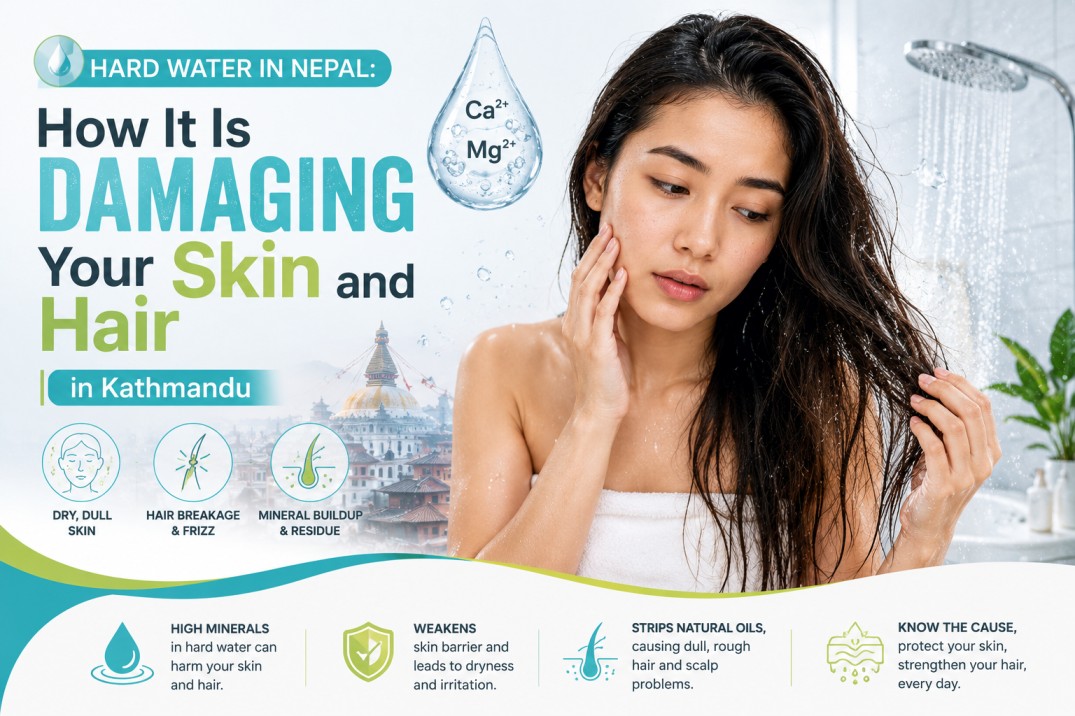
Hard water skin hair Nepal, this is one of the most common and most overlooked skin and hair problems in Kathmandu. You buy the right products. You follow a skincare routine. You drink enough water. But your skin still feels dry and rough, and your hair still falls out more than it should. If this sounds familiar, the problem might not be what you are putting on your skin. It might be the water you are using to wash it.
Kathmandu’s water supply has a hard water problem. Research published in the IWA Publishing Journal of Water, Sanitation and Hygiene found that water hardness in Kathmandu valley ranges from 20 to 254.6 mg/L, with groundwater from wells frequently exceeding 180 mg/L. A further study by Pant (2011) found that groundwater in the Kathmandu valley contained hardness as high as 800 mg/L. The majority of Kathmandu residents, whether in Thamel, Lalitpur, Bhaktapur, Baneshwor, or Patan, rely on KUKL municipal supply or private borewells, both of which carry dissolved calcium and magnesium minerals that accumulate on and in your skin and hair every single day.
In this guide, we explain exactly what hard water is, why Kathmandu’s water is hard, and, most importantly, how hard water skin and hair damage in Nepal shows up on your body and what you can do to protect yourself. If your skin or hair has been struggling without a clear reason, this could be the answer. Our skin specialists in Kathmandu at Nepal Skin Hospital see patients every week whose skin and hair problems are worsened, or even caused by Kathmandu’s hard water.
What Is Hard Water and Why Is Kathmandu’s Water Hard?
Water is called hard when it contains high levels of dissolved minerals, mainly calcium (Ca²⁺) and magnesium (Mg²⁺). These minerals dissolve naturally as water passes through rock formations like limestone, chalk, and dolomite underground. The more minerals dissolved in the water, the harder it is.
Kathmandu sits in a valley surrounded by hills. Its groundwater travels through layers of mineral-rich sediment before reaching homes via borewells, tube wells, and the KUKL supply system. According to a 2023 groundwater quality study of Kathmandu Valley, conductivity and hardness values were significantly higher in well water across the valley, with calcium and magnesium consistently among the most elevated minerals in groundwater samples.
In Lalitpur Metropolitan City, one of Kathmandu’s densest urban areas, a 2023 study published in Taylor & Francis found calcium levels in shallow dug wells ranging from 25.6 to 191.2 mg/L in winter, with the highest concentrations recorded during the dry season when groundwater levels drop and mineral concentration increases.
This is important for your skin and hair. The WHO safe limit for water hardness is 200 mg/L. Many borewells in Kathmandu, particularly in areas like Baneshwor, Koteshwor, Kalanki, and the surrounding districts, regularly exceed this level. And unlike drinking water, the effects of hard water on skin and hair are cumulative. Every shower, every face wash, every hair rinse adds another layer of mineral damage.
How Hard Water Skin Hair Damage Actually Happens in Nepal
Hard water does not hurt your skin or hair in one dramatic moment. It does it slowly, every single day, through a series of chemical reactions. Here is exactly what happens:
What hard water does to your skin
When you wash your face or body with hard water, the calcium and magnesium ions in the water react with the fatty acids in your soap or cleanser. Instead of producing a rich, cleansing lather, they form a sticky, insoluble residue called soap scum. This soap scum sits on the surface of your skin even after rinsing.
This residue causes three things:
- Skin barrier damage. A landmark study from the University of Sheffield found that hard water increases the deposition of harsh chemicals from soap, including sodium lauryl sulfate (SLS), onto the skin. This residue strips the skin’s natural lipid barrier, the protective layer of fats that keeps moisture in and irritants out.
- Increased transepidermal water loss (TEWL). When the skin barrier is broken down by hard water minerals, the skin loses water faster. This is called transepidermal water loss. The result is skin that feels tight, rough, and dry, even if you moisturise regularly. According to Healthline, hard water exposure reduces skin hydration, increases skin redness, and raises levels of cytokines, proteins that drive inflammation.
- pH disruption. Healthy skin has a slightly acidic pH of 4.5 to 5.5. Hard water and the soap scum it creates are alkaline. When your skin becomes more alkaline, its ability to fight bacteria and retain moisture is significantly reduced. Bacteria thrive at higher pH levels, meaning hard water can worsen acne and skin infections in Kathmandu residents.
What hard water does to your hair
Every time you wash your hair with hard water in Kathmandu, calcium and magnesium ions bind to your hair shaft. Over time, this mineral buildup creates a film around each strand. This film does several damaging things:
- It makes hair feel rough, dull, and straw-like, even when using good conditioner.
- It prevents shampoo and conditioner from working effectively because the minerals interfere with the cleansing and moisturising process.
- It weakens the hair shaft. Research cited by Alloroots (2025) found that hair samples treated with hard water had lower tensile strength, meaning they break more easily than those treated with soft water.
- It builds up on the scalp, clogging follicles, causing dryness, flaking, and irritation that worsens dandruff.
- It raises the pH of the scalp. A healthy scalp has a pH of around 4.5 to 5.5. Hard water pushes this higher. At higher pH, the cuticle of the hair shaft opens and becomes rough, making hair more prone to frizz, breakage, and tangling.
Over months and years of washing with hard water in Kathmandu, these effects accumulate, resulting in hair that is noticeably thinner, weaker, and more prone to falling out than it should be.
Signs of Hard Water Skin Hair Nepal Damage Is Affecting You in Kathmandu
Hard water skin hair damage in Nepal often goes unrecognised because people assume the problem is their products, their diet, or genetics. Here are the specific signs to look for that suggest hard water is the hidden cause:
Signs that hard water is affecting your skin in Kathmandu
- Your skin feels dry and tight after every shower or face wash, even when you apply moisturiser immediately after.
- You have persistent dry patches on your face, arms, or legs that do not fully respond to moisturising.
- Your skin looks dull, flat, and lacks its natural glow, even when you are eating well and staying hydrated.
- You have increased acne or clogged pores, especially if you recently moved to Kathmandu from a different city or area.
- Your eczema or psoriasis flares up more frequently. A
A 2021 meta-analysis of 16 studies confirmed that people exposed to hard water have a higher risk of eczema, likely due to skin barrier damage and pH change caused by mineral deposits. Read our detailed guide on eczema in children and adults to understand how hard water may be triggering your flare-ups.
- White or chalky residue appears on your skin after water dries, a direct sign of high mineral content.
- Soaps and cleansers do not lather properly and leave a sticky film on your skin after rinsing.
Signs hard water is affecting your hair in Kathmandu
- Your hair feels rough, coarse, or straw-like even after conditioning.
- You notice more hair on your pillow, in the shower drain, and on your comb than usual.
- Your hair looks dull and lacks shine, even when freshly washed.
- Your scalp feels itchy, dry, or flaky, and dandruff shampoos are not resolving it.
- Your hair is harder to detangle and breaks easily during combing.
- Your hair feels different when you travel outside Kathmandu and wash with softer water, lighter, smoother, and easier to manage.
That last point is a very strong indicator. Many Kathmandu residents notice their hair feels significantly better when they travel to areas with naturally softer water, and worse again when they return. This is one of the most reliable ways to identify hard water as the cause of your hair fall in Nepal.
Who Is Most Affected by Hard Water Skin Hair Nepal Damage in Kathmandu?
Hard water affects everyone in Kathmandu to some degree. But certain groups face a significantly higher risk of serious skin and hair damage:
- People with eczema, psoriasis, or atopic dermatitis. Hard water is a known trigger for flare-ups. The British Journal of Dermatology found that adults exposed to water with more than 200 mg/L of calcium carbonate were significantly more likely to experience persistent eczema symptoms.
- People with sensitive or dry skin. If your skin barrier is already compromised, hard water accelerates damage and makes recovery much harder.
- Residents are using borewell water. Borewell water in Kathmandu, particularly in areas like Koteshwor, Kalanki, Baneshwor, Kirtipur, and Bhaktapur, typically has higher mineral concentrations than the treated KUKL municipal supply. If your home runs on a private borewell, hard water damage is likely more severe.
- People who shower or wash their hair with hot water. Hot water opens the pores and hair cuticle, allowing more minerals to deposit on and in the skin and hair. Kathmandu residents who use hot water regularly for bathing are at higher risk.
- Children and infants. Children’s skin barriers are still developing. Hard water exposure in infancy has been linked to increased eczema risk. In one study of 1,303 infants, those exposed to hard water had a significantly higher risk of developing atopic eczema.
- People with existing hair fall problems. If you already have androgenic alopecia or thinning hair, hard water significantly worsens the problem by weakening hair shafts and clogging follicles. Read our complete guide on hair transplant in Nepal for long-term solutions to hair loss in Kathmandu.
Kathmandu Areas Most Affected by Hard Water Skin Hair Nepal Damage
Not all areas of Kathmandu have equally hard water. The hardness depends primarily on whether the water comes from the KUKL municipal supply or from private borewells. Areas that rely heavily on groundwater from borewells, particularly in the valley’s outer zones, tend to have harder water than areas served by treated municipal supply.
Based on the groundwater quality research available, the following Kathmandu areas are most likely to experience harder water:
- Lalitpur / Patan. Groundwater calcium levels in Lalitpur’s dug wells ranged up to 191.2 mg/L in winter, according to the 2023 Taylor & Francis study. Residents using private wells are at particular risk.
- Bhaktapur is primarily dependent on groundwater from wells. One of the harder water zones in the valley.
- Baneshwor, Koteshwor, Kalanki Dense urban zones with high borewell dependency. Mineral concentrations typically higher than in centrally-supplied areas.
- Kirtipur is historically underserved by municipal supply and is reliant on groundwater.
- Outer ring areas and new settlements Newer residential areas around the Kathmandu ring road that have outpaced KUKL infrastructure and rely on private borewells.
However, even residents using the KUKL municipal supply are not immune. The same research confirms that conductivity and dissolved mineral content in KUKL groundwater sources across the valley are significantly elevated compared to international benchmarks for skin-safe water.
How to Protect Your Skin and Hair from Hard Water in Nepal
The good news is that hard water skin and hair damage in Nepal can be significantly reduced with the right daily habits. You cannot easily change the water supply in Kathmandu, but you can change how you interact with it. Here is a complete, practical guide:
1. Use lukewarm water, never hot
Hot water opens your skin pores and hair cuticles wide, allowing more calcium and magnesium minerals to penetrate deeper. Switch to lukewarm water for all face washing and showering. This one change alone can make a meaningful difference to both skin hydration and hair texture in Kathmandu.
2. Cleanse with a gentle, pH-balanced cleanser
Hard water reacts badly with soaps containing sodium lauryl sulfate, creating the soap scum that damages your skin barrier. Switch to a gentle, pH-balanced, sulphate-free cleanser. A cleanser with a slightly acidic pH (4.5 to 5.5) helps counteract the alkalising effect of Kathmandu’s hard water and supports your skin’s natural acid mantle.
3. Apply moisturiser immediately after washing
Because hard water increases transepidermal water loss, locking in moisture immediately after washing is critical. Apply a generous amount of moisturiser within 3 minutes of drying your face or body, while your skin is still slightly damp. This traps the existing moisture before the hard water minerals can draw it out.
Moisturisers containing ceramides, hyaluronic acid, and glycerin are particularly effective because they actively repair and reinforce the skin barrier that hard water breaks down. Follow our daily skincare routine guide for a complete step-by-step approach that works for Nepali skin in Kathmandu’s environment.
4. Use a chelating or clarifying shampoo for hair
A chelating shampoo is specifically formulated to bind to and remove mineral deposits, calcium, magnesium, and iron, from the hair shaft. Using one once a week or every two weeks removes the hard water buildup that dulls, weakens, and weighs down hair. After chelating, always follow with a good conditioner to restore moisture.
This is one of the most effective and immediate solutions for hard water hair fall in Nepal. Many people in Kathmandu notice dramatic improvement in hair texture and reduced breakage within 3 to 4 weeks of adding a chelating shampoo to their routine.
5. Do an apple cider vinegar rinse once a week
Apple cider vinegar has a naturally acidic pH of around 3. When diluted and used as a final hair rinse, it helps neutralise the alkaline residue left by hard water, close the hair cuticle, remove some mineral buildup, and restore the scalp’s natural pH balance. Dilute one tablespoon in a cup of water and pour through washed hair. Leave for 2 minutes, then rinse thoroughly. Hair feels noticeably smoother and softer.
6. Install a shower filter
A shower filter, attached to your showerhead, reduces the mineral content of water before it reaches your skin and hair. They are widely available in Kathmandu’s hardware and plumbing shops as well as online. Filters that use KDF (Kinetic Degradation Fluxion) or activated carbon are effective at reducing calcium, magnesium, and iron in hard water. For Kathmandu residents on borewells, this is one of the most cost-effective long-term investments for skin and hair health.
7. Use distilled or purified water for face washing
If your skin is particularly sensitive or you are managing a condition like eczema, consider washing your face with purified or boiled-then-cooled water rather than direct tap or borewell water. This removes most dissolved minerals and significantly reduces the irritation they cause to sensitive Nepali skin.
8. Support hair and skin from the inside
Hard water depletes the minerals your skin and hair need. Support your body’s repair process from within with a diet rich in protein, zinc, iron, and vitamins A, C, and E. For hair health specifically, foods like eggs, fish, lentils, spinach, and nuts provide the nutrients follicles need to grow strong. Stay well hydrated, at least 8 glasses of water daily, using purified drinking water.
When Hard Water Damage Needs Professional Treatment
Daily home care goes a long way. But if hard water skin hair Nepal damage has already caused visible or persistent problems, professional dermatological treatment is the most effective path to genuine recovery. Specifically, see a skin specialist if:
- Your skin has chronic dryness, eczema flare-ups, or sensitivity that does not improve despite switching to gentle products and lukewarm water.
- Your acne has worsened despite a good skincare routine; hard water may be disrupting your skin’s pH and contributing to breakouts. Read our full guide on
How to treat acne in Kathmandu.
- Your hair fall has increased significantly and is not improving after 6 to 8 weeks of chelating shampoo use and dietary changes.
- You have visible scalp problems, persistent dandruff, flaking, or a red, irritated scalp that does not respond to over-the-counter solutions.
- You want a professional assessment to determine whether your hair fall is caused primarily by hard water damage, androgenic alopecia, nutritional deficiency, or a combination of factors.
At Nepal Skin Hospital, our dermatologists offer comprehensive skin and scalp assessments specifically for patients in Kathmandu dealing with hard water-related damage. Professional treatments available include chemical peeling for skin renewal and deep mineral residue removal, as well as PRP therapy and hair restoration treatments for hard water-related hair fall.
Frequently Asked Questions About Hard Water Skin Hair Nepal
Does hard water in Kathmandu cause permanent hair loss?
Hard water does not cause permanent hair loss in the same way that androgenic alopecia (genetic pattern baldness) does. However, it causes chronic mechanical damage to the hair shaft, weakening it, increasing breakage, and contributing to accelerated shedding. Over time, this can worsen existing hair thinning significantly. Treating the hard water damage promptly, with the right shampoo, diet, and if necessary, professional care, allows full recovery in most cases.
Does hard water in Kathmandu cause permanent hair loss?
Hard water does not cause permanent hair loss in the same way that androgenic alopecia (genetic pattern baldness) does. However, it causes chronic mechanical damage to the hair shaft, weakening it, increasing breakage, and contributing to accelerated shedding. Over time, this can worsen existing hair thinning significantly. Treating the hard water damage promptly, with the right shampoo, diet, and if necessary, professional care, allows full recovery in most cases.
Does hard water in Kathmandu cause permanent hair loss?
Hard water does not cause permanent hair loss in the same way that androgenic alopecia (genetic pattern baldness) does. However, it causes chronic mechanical damage to the hair shaft — weakening it, increasing breakage, and contributing to accelerated shedding. Over time, this can worsen existing hair thinning significantly. Treating the hard water damage promptly, with the right shampoo, diet, and if necessary, professional care, allows full recovery in most cases.
Is KUKL water in Kathmandu hard?
KUKL municipal water in Kathmandu contains dissolved minerals, but typically at lower concentrations than private borewell water. According to published research on Kathmandu municipal water quality, total hardness in KUKL-supplied water varies depending on the source and season. Water hardness is generally higher in the dry winter months (November to March) when groundwater levels drop and mineral concentration increases, and slightly lower during and after the monsoon when fresh rainwater dilutes the supply.
Is hard water the reason my skin is dry in Kathmandu?
It is very likely a contributing factor, especially if your skin feels dry even when you moisturise regularly, drink enough water, and use gentle products. Hard water strips the skin’s lipid barrier and increases transepidermal water loss, meaning skin loses moisture faster than it can retain it. Switching to lukewarm water, a pH-balanced cleanser, and a ceramide-rich moisturiser often produces noticeable improvement within 2 to 4 weeks.
What is the best shampoo for hard water hair fall in Nepal?
Chelating shampoos, formulated with EDTA (ethylenediaminetetraacetic acid) or similar chelating agents, are specifically designed to remove mineral buildup from hard water. Used once or twice a week, they lift calcium and magnesium deposits from the hair shaft, restoring softness, shine, and reducing breakage. Always follow with a good moisturising conditioner. Our dermatologists can recommend the most suitable options for your specific hair type during a consultation.
Can a shower filter really help my skin and hair in Kathmandu?
Yes, a shower filter that reduces calcium and magnesium content can make a meaningful difference to both skin hydration and hair health. Many Kathmandu residents who install filters report noticeably softer skin and less hair fall within a few weeks. They are widely available in Kathmandu and represent excellent value compared to the long-term cost of treating the skin and hair damage caused by unfiltered hard water.
Final Thoughts: Hard Water Skin Hair Nepal Damage Is Real, But Very Manageable
Hard water skin hair Nepal damage is one of the most common, and most commonly missed, reasons why Kathmandu residents struggle with persistent skin dryness, hair fall, and scalp problems. The water you use every day to wash your face and hair is quietly working against you. But now that you know, you can do something about it.
Start with the basics: switch to lukewarm water, use a gentle pH-balanced cleanser, apply moisturiser immediately after washing, and add a chelating shampoo to your hair routine once a week. These simple changes, done consistently, produce real improvements in skin hydration and hair health for most people in Kathmandu within 3 to 4 weeks.
If your skin or hair problems run deeper, or if you want a professional assessment of exactly how hard water is affecting your specific skin and hair type, book a consultation with our team at Nepal Skin Hospital. We understand the specific skin and hair challenges of living in Kathmandu, and we are here to help you tackle them with the right care. Because your skin and hair deserve better than hard water damage, and the solution starts today.