

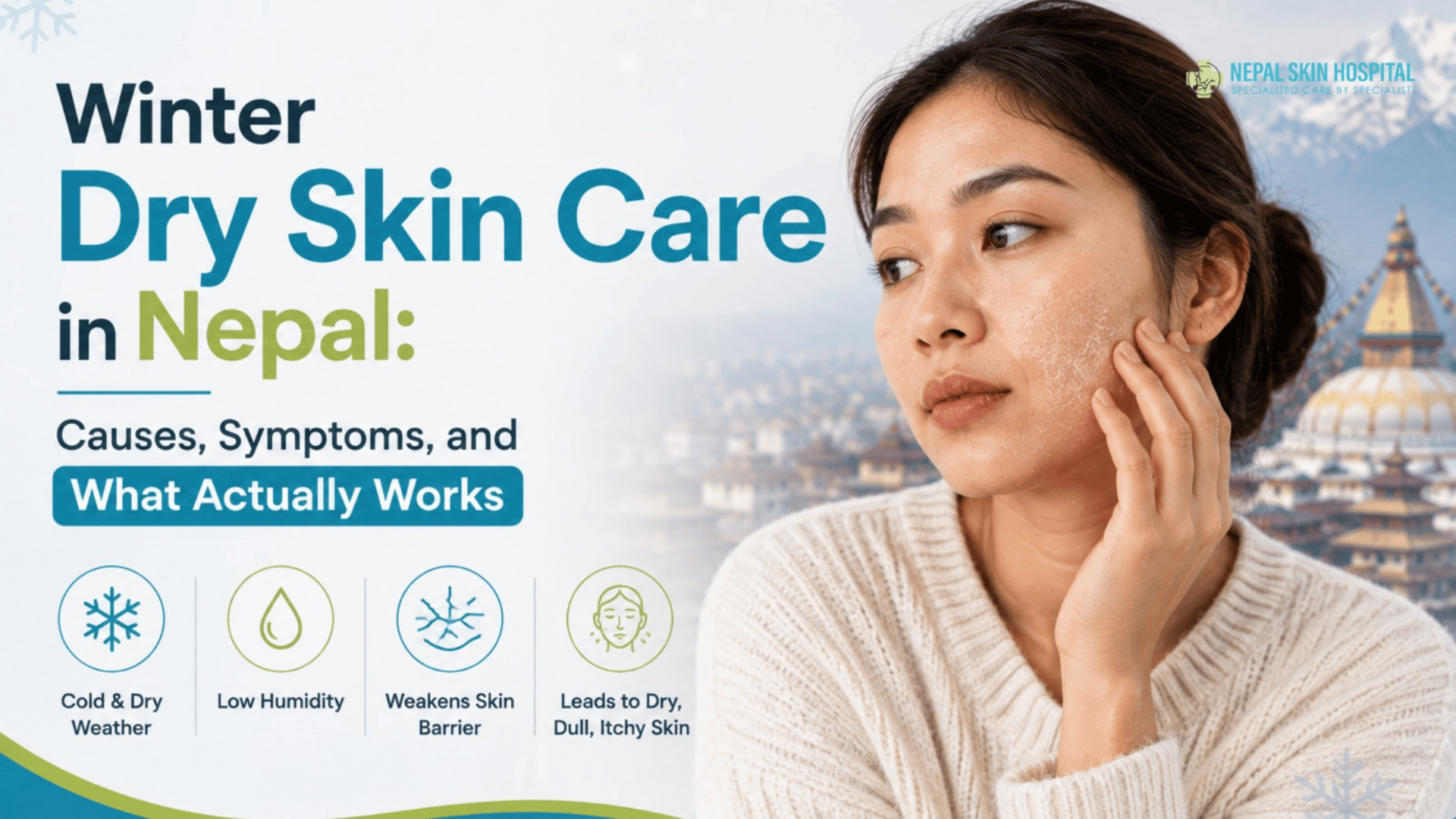
Winter dry skin in Nepal is one of the most common seasonal complaints dermatologists see between November and February. It is also largely preventable once you understand what’s actually causing it. As Kathmandu’s temperature drops and indoor heating use rises, the skin’s natural moisture barrier weakens. This leads to tightness, flaking, and itching, and in more severe cases, cracked skin and eczema flare-ups.
Good winter dry skin care in Nepal comes down to the right combination of daily habits and product choices. Winter xerosis, the medical term for dry skin, typically responds within two to three weeks of consistent care.
This guide covers why winter is harder on skin in Kathmandu specifically than in many other cities, how to tell mild dryness from a condition that needs a dermatologist, and a complete step-by-step routine you can start today.
Key facts on winter dry skin care in Nepal: January is Kathmandu’s coldest month, with average highs of just 19.1°C and lows dropping to 2.4°C. It also carries the lowest UV index of the year, at around 5, according to climate data compiled by Weather Atlas.
Air quality research from the Kathmandu Valley found that fine particulate matter (PM2.5) runs roughly 3.6 times higher during the dry winter season than during the monsoon. PM2.5 is known to damage the skin barrier and increase water loss, based on the NAMaSTE air quality study published via PMC.
A 2026 infodemiology study in JMIR Dermatology confirmed something similar. Population-level interest in dry skin and moisturizing products tracks closely with drops in temperature and humidity. This is a genuine climate-driven pattern, not just a seasonal habit.
Why Winter Skin Is Worse in Kathmandu Than Many Other Cities
Kathmandu’s winter combines several stressors at once. Most general “winter skincare” advice does not account for this. Each stressor damages the skin barrier on its own. Together, they compound.
1. Cold, Dry Air Increases Water Loss
When outdoor humidity drops, a moisture gradient forms between your skin and the air. Water gets pulled out of your skin faster than it can be replaced. This is the core mechanism behind winter xerosis everywhere, as explained in Harvard Health’s guide to winter dry skin.
2. Kathmandu’s Winter Air Pollution Makes It Worse
Fine particulate pollution spikes sharply in the Kathmandu Valley during dry winter months. This matters for skin health because PM2.5 particles are small enough to penetrate the skin barrier. They trigger oxidative stress and worsen moisture loss, sensitivity, and inflammation. Kathmandu’s winter PM2.5 levels have been recorded far above WHO air quality guidelines during this season.
3. Hot Showers and Heaters Strip Natural Oils
It is tempting to shower in very hot water during Kathmandu’s cold mornings and evenings. But hot water dissolves the lipid layer that keeps skin waterproof. Skin ends up drier after each wash than before.
4. Hard Water Compounds the Problem
Many Kathmandu Valley households rely on groundwater or tanker-supplied water with high mineral content. This can leave a residue on skin and stop soap from rinsing off cleanly. If your skin feels unusually tight or rough after washing, regardless of the season, it’s worth reading our detailed guide on hard water’s effect on skin and hair in Nepal.
5. Wind and Low Sun Exposure Reduce Skin Resilience
Kathmandu’s winter carries noticeably drier winds than the monsoon or spring. Shorter daylight hours and a lower UV index also mean people spend less time thinking about skin protection. Moisturizer often gets neglected entirely as a result.
Dermatologists writing in the Kathmandu Post’s 2026 feature on seasonal skincare confirm this pattern clinically. Cold, dry air increases water loss and makes skin more prone to peeling, sensitivity, and flare-ups of conditions like dermatitis. Separately, dermatologists interviewed on seasonal skin conditions in Nepal note that winter is specifically linked to xerosis, chilblains, and psoriasis flare-ups. Children commonly develop atopic dermatitis during this period too.
How Severe Is Your Dry Skin? A Quick Self-Check
| Severity | What It Looks Like | What It Feels Like | What To Do |
| Mild | Slight flaking, dull texture | Occasional tightness after washing | Daily moisturizer + shower routine changes (see below) |
| Moderate | Visible flaking, rough patches, fine cracks | Persistent tightness, mild itching | Add a dedicated barrier-repair cream, avoid harsh cleansers |
| Severe | Deep cracks, redness, bleeding, thickened patches | Constant itching, pain, disrupted sleep | See a dermatologist; may indicate eczema or another underlying condition |
Bottom line: Mild and moderate winter dryness usually responds to home-care changes within two to three weeks. If cracking, bleeding, or intense itching persists beyond that, it needs a clinical evaluation rather than a stronger moisturizer.
Step-by-Step: Winter Dry Skin Care in Nepal That Actually Works
Some of the essential steps for skin care during winter are mentioned below:
- Switch to lukewarm water, not hot. Keep showers under 10 minutes and avoid water hot enough to fog a mirror. This single change prevents the most common cause of winter flare-ups.
- Use a gentle, fragrance-free cleanser. Foaming and heavily scented soaps strip the skin’s natural oils faster than cream or gel cleansers designed for dry or sensitive skin.
- Apply moisturizer within three minutes of washing. This is the single most important timing rule in dermatology for locking in water before it evaporates from damp skin.
- Layer a humectant, then an occlusive. Apply a lightweight humectant serum first, followed by a thicker cream or ointment to seal moisture in, especially on hands, elbows, and lower legs where dryness is usually worst.
- Use a humidifier if you rely on heaters. Room heaters and wood-burning stoves, common in Kathmandu homes during winter, dry out indoor air significantly and undo the benefit of a good skincare routine overnight.
- Don’t skip sunscreen entirely. Even at Kathmandu’s lower winter UV index, daily SPF still matters for anyone being treated for pigmentation conditions such as melasma, which can worsen with any UV exposure, even on cloudy winter days.
- Reassess after 2-3 weeks. If flaking, cracking, or itching hasn’t meaningfully improved, book a consultation rather than continuing to try new over-the-counter products.
Humectants vs. Emollients vs. Occlusives: What to Actually Look For
| Ingredient Type | What It Does | Common Examples | Best Used |
| Humectant | Draws water into the skin | Glycerin, hyaluronic acid, urea | On slightly damp skin, under a heavier cream |
| Emollient | Smooths and softens by filling gaps between skin cells | Ceramides, fatty acids, squalane | Daily, for most skin types |
| Occlusive | Forms a protective seal to prevent water loss | Petrolatum, shea butter, dimethicone | Nighttime or on severely dry patches (hands, heels) |
Bottom line: A moisturizer that lists a humectant and a ceramide-based emollient together, ideally with an occlusive layer at night, addresses winter dryness far more effectively than a single “moisturizing” cream with only water and fragrance.
What Not to Do: Common Winter Skincare Mistakes in Nepal
To keep your skin healthy during winter, it is important to avoid these common skincare mistakes:
- Over-washing hands and face: Frequent washing with hot water, especially common in winter due to cold-and-flu season hygiene habits, repeatedly strips protective oils faster than they can be replenished.
- Skipping moisturizer because skin “doesn’t feel oily”: Winter dryness is often mistaken for normal skin because the usual summer shine disappears, leading people to stop moisturizing at exactly the time they need it most.
- Using body lotion marketed for “brightening” or “fairness” as a treatment for cracked, flaking skin: These formulations are often not designed for barrier repair and, per research published in the Journal of the Nepal Medical Association on topical corticosteroid misuse among Nepali dermatology outpatients, can contain undisclosed steroids that worsen skin barrier damage over time.
- Sitting directly next to heaters or fires for long periods: This dries the surrounding air dramatically and accelerates moisture loss from exposed skin.
- Ignoring cracked heels and hands until they bleed: Small cracks are far easier to treat than deep fissures, which can become entry points for infection.
Frequently Asked Questions About Winter Dry Skin Care in Nepal
Why does my skin get so dry every winter in Kathmandu specifically?
Kathmandu’s winter combines low humidity, cold temperatures, and a sharp seasonal spike in air pollution, all of which independently damage the skin’s moisture barrier. Add common habits like hot showers and heater use, and the effect compounds quickly compared to milder or more humid climates.
Is it normal for winter dry skin to itch?
Mild itching from dryness is common and usually resolves once the skin barrier is restored with proper moisturizing. Persistent, intense, or worsening itching, particularly if accompanied by redness or cracking, can indicate eczema or another condition that needs a dermatologist’s assessment rather than home treatment alone.
Can hard water make winter dry skin worse in Nepal?
Yes. Hard water, common across much of the Kathmandu Valley, can leave mineral residue on the skin and interfere with how well cleansers rinse away, compounding the dryness already caused by cold winter air. See our full guide on hard water’s effect on skin and hair in Nepal for more detail.
How long does it take for winter dry skin to improve?
With consistent lukewarm showers, gentle cleansing, and proper moisturizer layering, most mild to moderate winter dryness improves within two to three weeks. Severe cases with cracking or bleeding usually need a dermatologist-prescribed barrier-repair regimen and can take longer.
Should I stop using sunscreen in winter since there’s less sun?
No. Kathmandu’s UV index is lower in winter, but not zero, and UV exposure still contributes to pigmentation conditions such as melasma even on cold or cloudy days. Sunscreen should continue year-round, particularly for anyone undergoing pigmentation treatment.
When to See a Dermatologist for Winter Dry Skin
Most winter dryness responds to home care, but you should book a consultation if you notice:
- Cracking deep enough to bleed, especially on hands, heels, or knuckles
- Redness, swelling, or intense itching that disrupts sleep
- Thickened, scaly patches that don’t improve with moisturizer after 2-3 weeks
- Dry skin accompanied by a rash, which may indicate eczema or another underlying condition rather than simple seasonal dryness
Our dermatologists at Nepal Skin Hospital can assess whether your winter skin concerns are simple seasonal dryness or something that needs a targeted treatment plan. Book a consultation if home care hasn’t resolved your symptoms within a few weeks.